Showing posts with label banks. Show all posts

04 March, 2013

Too Big for Bonuses

English: Wall Street sign on Wall Street
English: Wall Street sign on Wall Street (Photo credit: Wikipedia)
"Michael," of "Bankers Anonymous," does a very nice job of taking apart the argument in favor of large bonuses for Wall Street bankers.  As he points out, it makes perfect sense to have a system of bonuses regularly in excess of annual salaries in a business noted for risk, with a premium on rewarding the very best and brightest. Accept the assumptions, and the conclusions follow.

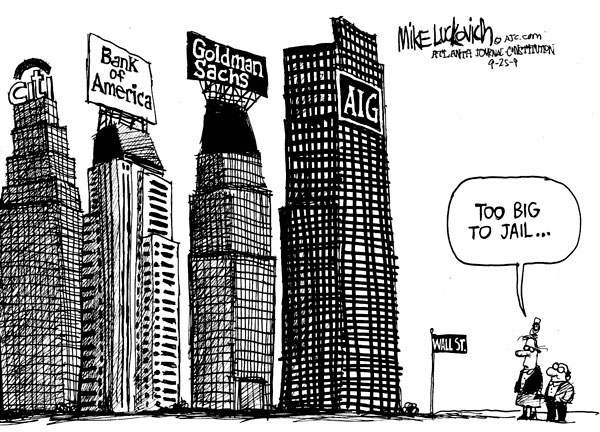
BUT..and you knew this was coming, didn't you?...when dealing with "Too Big to Fail" banks THE ASSUMPTIONS ARE NOT TRUE.  Risk is minimized and underwritten by the public underwriting of losses for megabanks.  Much as Freddie Mac and Sallie Mae were (are) ostensibly "private" institutions, set up by government, supported by government, guaranteed (formally or informally) by government, the superbanks have grown (with the regulatory and policy collusion of government) to the point that they are, in fact, not private in most important ways.

"Michael" puts it better than I:
...As long as you know the government’s got your back, you’re not really private. 
If you’re Too-Big-To-Fail, you’re Amtrak in my book.  None of you should get more than a few hundred thousand annually.  And that’s being generous. 
Now, before you accuse me of being a Communist, or a Wall Street hater, let me clarify. 
I love private enterprise. 
I applaud successful hedge fund managers, for example, and I do not begrudge their extraordinary compensation, provided they follow the rules and manage capital for willing investors. 
One of the keys to my applause, however, is my belief that any of those hedge funds could disappear tomorrow, as a result of a bad bet, misplaced customer funds, or a faulty computer algorithm, and no government entity will step up to save their bacon. 
I long for the day when the employees of Wall Street banks can reap legitimate profits, if they deserve it, or similarly disappear without a whimper, if they deserve it. 
If the Too-Big-To-Fail banks managed to break themselves into systemically irrelevant parts, I would have no problem with their executives paying themselves massive bonuses in good years.  They’d have earned it. 
But until that day, when they’re finally Too-Small-For-Bailouts, please don’t pretend that they’re anything more than a big NASA – a bunch of smart people in a big room full of flat screens, filling an important government-subsidized mission – working on the taxpayer’s dime.
Logically, you can't have it both ways. If the banks (or any other entity) are so important they function as a public utility--and that's essentially the justification for the bailout--they need to be regulated as a public utility, and their jobs need to be compensated in a way and to a degree similar to those of any other public utility.

Are Banker Bonuses Fair? - Business Insider

06 March, 2012

Anonymous strikes again

Anonymous disrupted the website of the Greek Ministry of Justice late last month.

The message, in greek (of course) is supposed to read something like this (and note that I've taken some liberties to make the translation flow better):


Citizens of Greece
     We are Anonymous.
     
We watch every day as your government abolishes the constitution and institutions of the country.
     
We see them leading you closer and closer to poverty.
     
We see them pass laws that deprive you of any right to dignity.
     
We see them deliver the country to the IMF and the bankers.
     
We know about the soup kitchens in schools,
     
for people who are left jobless and now wait in queues for a plate of food.
     
We know that your country voted for ACTA in your effort to silence other Greeks.
     
We know everything ...
     
The Republic in Greece has died.
     
It died with a government that has not been elected by the people.
     
And for this reason the time for discussion came and went.
     
Not negotiating anything with any of those who murdered it.
     
You can hunt as you like, you can even capture some of us,
     But w
hen you attempt to silence us ...
     F
or every one that will you capture 3 others will spring up. Five or ten or a hundred.
     
Now the Greeks are all Anonymous.
     We are millions against you and the 300.  In this war tear gas will not help you.
     To the Occupying Government of Greece
     
These days is going to vote for a bill that will be the last nail in the coffin of Greece.
     
A bill to return the country to a totalitarian rule.
     
To bring the country and its people in absolute poverty.
     
We will not allow more misery to the Greek people.
     
We demand your resignation immediately, and elections.
     
We demand that not a cent be paid to your moneylender 'friends.'
     
We demand the immediate withdrawal of the IMF from Greece.
     
Justice Department, this is only a small sample of what we're capable of doing.
     Y
ou have not seen the full wrath of Anonymous.
     
For each article of a bill that would shame the vote,
     
we will shut down the system and delete the Internal Revenue debts of Greek citizens.
     
Debts which requires them to pay the fascists.
     
The demonstrations of the Greeks have had their encounter with incredible violence,
     
anexelekta hitting, but the internet is our field. And we love this war.

     We are many and we will be swift.
     Citizens of Greece, Anonymous is now fighting on your side ... 
     Government of Greece, let us wait ...

     E X P E C T  U S !
     J U S T I C E  I S  C O M I N G !

The Greek police announced the arrest of three teenagers for the hack.  But the meme goes on--Anonymous has brought down the MoJ website with a DDoS attack, in retribution for the arrests.
In other news, several members of LulzSec, the group that left Anonymous to follow its own agenda--including the recent hack of Stratfor--have been arrested.  It seems that the FBI was able to get one leader to turn on his buddies.  The organization may be crippled.  That is what happens when you start moving from leaderless resistance to a collection of leaders and followers.


27 January, 2012

This is what journalism looks like

You may have missed this.  And even if you'd seen it you might not have recognized it.  It's called journalism.  We used to have it in the United States.

03 January, 2012

One empire down, one to go?


Here's an interesting perspective on where we've been and where we're going, as articulated by Monika Halan:
The fracturing post-World War II equations showed through the plaster in 2011. The 63-year period from 1945 to 2008 will be remembered as the time when two dominant ideas about people and money, and how we choose to organize ourselves around these ideologies, died. One version delinked people from money; the other put money before people. The first collapse was in 1991 when the dominant interpretation of collectivism shattered the Soviet Union into 15 shards. The classless, moneyless, stateless, egalitarian society, which took from each according to his ability and gave to each according to his need, crumbled under the weight of authority and effort that was needed to impose something so state-centric and unnatural in place. Progress does get measured by money, and the severe scarcities and the dysfunctional economies of the Soviet bloc hastened the collapse—the delinking of people and money did not hold true. 
But handing over the keys to the market caused another collapse, and 2008 was when the interpretation of individualism in the form of predatory capitalism began its death dirge when the US’ financial sector demonstrated what unregulated greed can do. This version of capitalism (which was not what Adam Smith envisaged) delinked risk from reward, made a section of labour behave like capital, and made governments subordinate to the transnational corporation. That version of capitalism, emboldened by the breakdown of communism, pushed for and got what were called “free” markets and “less” government. But markets, as was later found out, were not really free—but compromised by the 1% who held the levers of control to move the system. And move it they did, towards appropriating more and more for themselves.
But there's more to it than that: both post-war empires overextended themselves. The Soviets couldn't pull back and manage a real "restructuring" (perestroika) and failed to keep "openness" (glasnost') under sufficient control to keep the empire intact. Today, with greater technologies for information transparency--and heavy-handed attempts to restrict it--the parallels for the US are too close for comfort. Do we really think the TSA is just for the external threat?

And then there's the Chinese. The Chinese government is watching the various "Springs" of recent history and finding it's too vulnerable for comfort. Little noticed in the growth of Chinese military power is the fact that the internal security forces now have a budget that rivals that of the PLA.

Old patterns of social organization and control are breaking down, but there's no consensus on what will replace them. Probably the best we can do is encourage experimentation, and see what works (and for whom) in various circumstances. But that's precisely what those in power are most opposed to trying. This could get interesting.

Liberty, Equality, Fraternity - Home - livemint.com

30 December, 2011

How bad is it?


Porter Stansbury, already noted for his gloomy predictions about the American economy, finds "the numbers tell us America is in decline... if not outright collapse."  His analysis starts with an estimate of real per capita GDP/time, based on a market-basket of currencies and/or gold.  Even this has pitfalls.  But, anyway, he uses a commodity index (the CRB) until 1975, and after the US is off the gold standard he switches to gold, and the chart looks like this:

I don't know that this is the best way to estimate what is going on, but clearly something is.  And this misses what may be the greatest problem of all: that per capita GDP tells us nothing about the distribution of wealth.  Things got better, it seems, in the years from Reagan to George W. Bush--but how much of that was consolidated in the hands of a few?  Even ignoring that, however, after 2001 things look bad for almost everyone.

Why bring this up here?  Because economic failure promotes desperation, and crime, and a police state mentality.

Stansbury connects the decline to an ethic of entitlement, coupled with vast (and unpunished) corruption at the top.  Henry Paulson and Tim Geitner should be behind bars for lying to Congress and providing more accurate insider information to old associates.  Congress doesn't do anything about it (perhaps because the Congress as a whole has an ever-widening gap with their consitutents, based in part on their exemption from insider-trading laws).

He also wants to claim that there's a direct correspondence to the Great Society programs, either by design (to buy off troublesome groups) or error (the basic errors of large-scale government planning systems).  That's debateable, but what isn't in doubt are the numbers--and the spiral of poverty and crime and incarceration they represent.  Some data points, again from Stansbury:

According to the NAACP, Texas taxpayers spent $175 million in 2009 to imprison residents from a small part of Houston – only 10 zip codes out of 75. Thus, people from neighborhoods that are home to only about 10% of the city's population account for more than 33% of the state's entire $500 million annual prison spending. These neighborhoods are overwhelmingly poor and African American. 
In Pennsylvania, taxpayers will spend $290 million in 2009 to imprison residents from just 11 of Philadelphia's neighborhoods, representing about 25% of the city population. On this relatively small urban area, the state will spend roughly half its $500 million prison budget. These neighborhoods are overwhelmingly poor and African American. 
In New York, taxpayers will spend $539 million to imprison residents from only 24 of New York City's 200 different neighborhoods. Only 16% of the city's population lives in these areas, but they will account for nearly half of the state's $1.1 billion prison budget. These neighborhoods are overwhelmingly poor and African American.

This is not about race, or at least not only about race.  In Detroit, where twenty-seven percent of African-American males graduate from high school, only nineteen percent of white males do so.  In practical terms, in an economy that's increasingly technical and global, these people have little or no chance.

My dad used to be a principal in the schools of St. Louis.  Eventually, he ended up in charge of the school for incarcerated minors.  I'm not sure what's worse: that he found that to be one of his safer assignments, or the fact that some of his students would commit crimes to get off the streets and return to the relative safely of his school.

Today, this country has more than seven million people in prison or on parole, more that any other industrialized state.  The prison population has grown from less than half a million people to more than 2.5 million today--and the building and running of prisons has become a profitable growth industry.  What does that say about us?

Stansbury identifies villians: democrats, republicans, government employee unions, big business.  I don't agree with all of his analysis.  But it's worth a look at the start of what is likely to be a very, very difficult year.

18 December, 2011

The "complex"

Some people hate and distrust "big business."  Some people hate and distrust "big government."  And so often they argue with one another: Tea-Party versus Occupy, if you were.  Yet when you get down to details it doesn't really make sense to fight about.  Big business or bid government, it's often the same people.  A case in point:
So what are we arguing about?

26 November, 2011

The impossible triangle

It's coming down to the crunch.  The Eurozone is caught in its version of the "Impossible Triangle" in international finance: among states you can have unrestricted trade in currencies and/or fixed exchange rates (or, in this case, a single currency) and/or sovereign financial and monetary policies, BUT YOU CAN'T HAVE ALL THREE AT THE SAME TIME.  Something has to give.  So what will it be?

EUROPE: Changing The Rules In The Middle Of The Game:

I have been writing for a very long time about the changes needed to the EU treaty if Europe is to survive. Specifically, last week I noted that Angela Merkel has made it clear that the independence of the ECB must not be compromised. This week Sarkozy and the new prime minister of Italy, Mario Monti, agreed to stop their public calls for such changes (at least until their own crises get even worse, would be my guess). And Merkel has called for a new, stronger union with strict control of budgets as the price for further German aid for those countries in crisis. In seeming response: 
“The European Commission on November 23 proposed a new package including budget previews at EU level, the establishment of independent fiscal councils and growth forecasts, closer surveillance of bailout recipients and a consultation paper on Eurobonds. There is also a growing consensus among EU policy makers on the need for the adoption of fiscal rules in national legislation. However, it is far from clear whether EU countries would accept the implicit loss of sovereignty this would involve and agree to treaty changes enshrining legally enforceable fiscal oversight at EU level. The German Chancellor, Angela Merkel, is willing to support a change in Germany’s own constitution if the EU Treaty change to that effect is agreed first.” ( www.roubini.com)But this means a major treaty change that must be approved by all member countries. Note that Merkel wants the treaty change first, or at least the language, before she takes it to German voters, which will certainly be required, since what she is suggesting is not allowed by the present German constitution. Without the changes stated clearly and explicitly in advance, it is unlikely, as I read the polls, that German voters will go along. Merkel has made it clear that any proposed changes will be limited to fiscal issues and central control and not touch on the ECB’s independence. She is adamant against eurozone bonds and putting the German balance sheet at risk (see more below). 
But will the rest of Europe go along with what would be a major alterations of their own individual sovereignty and their ability to adjust their own budgets, no matter what? And agree to all this in time to deal with the current crisis? Such changes will be controversial, to say the least. And they would require, if I understand, the yes votes of all 27 European Union members, or at a minimum the 17 eurozone members.
Unfortunately (?), some, but not everyone, are panicing:


On Friday, Standard & Poor’s downgraded Belgium’s credit standing to AA from AA+, saying it might not be able to cut its towering debt load any time soon. Ratings agencies this week cautioned that France could lose its AAA rating if the crisis grew. On Thursday, agencies lowered the ratings of Portugal and Hungary to junk. 
While European leaders still say there is no need to draw up a Plan B, some of the world’s biggest banks, and their supervisors, are doing just that.  “We cannot be, and are not, complacent on this front,” Andrew Bailey, a regulator at Britain’s Financial Services Authority, said this week. “We must not ignore the prospect of a disorderly departure of some countries from the euro zone,” he said. 
Banks including Merrill Lynch, Barclays Capital and Nomura issued a cascade of reports this week examining the likelihood of a breakup of the euro zone. “The euro zone financial crisis has entered a far more dangerous phase,” analysts at Nomura wrote on Friday. Unless the European Central Bank steps in to help where politicians have failed, “a euro breakup now appears probable rather than possible,” the bank said. 
Major British financial institutions, like the Royal Bank of Scotland, are drawing up contingency plans in case the unthinkable veers toward reality, bank supervisors said Thursday. United States regulators have been pushing American banks like Citigroup and others to reduce their exposure to the euro zone. In Asia, authorities in Hong Kong have stepped up their monitoring of the international exposure of foreign and local banks in light of the European crisis. 
But banks in big euro zone countries that have only recently been infected by the crisis do not seem to be nearly as flustered. 
Banks in France and Italy in particular are not creating backup plans, bankers say, for the simple reason that they have concluded it is impossible for the euro to break up. Although banks like BNP Paribas, Société Générale, UniCredit and others recently dumped tens of billions of euros worth of European sovereign debt, the thinking is that there is little reason to do mo
Evidently, the French banks are convinced someone MUST save them.  Denial?

'via Blog this'

20 November, 2011

Hard talk

I mentioned this in class the other day. The whole interview (from BBC) is worth the time. For many people, the idea of "saving" the Eurozone is turning into a (sad) joke. One of my favorite quotes:

"...you know how screwed up Europe is when you have a German pope and an Italian central banker."


The real fun begins around the 12:30 mark.

One nation under law