13 July, 2008

Holding hostages

If the United Nations is serious about its engagement with Sudan, it should tell [Luis Moreno-Ocampo] to suspend what he is doing with this so-called indictment. There will be grave repercussions.

--Abdalmahmood Abdalhaleem Mohamad, Sudan's ambassador to the UN.

So what's the proper response? It's times like these I wish we had a competent "Team America" (or Team UN) to go after the bad guys.

Playing to tie

This fits with what I've seen elsewhere, as well as Freedman's recent analysis on Stratfor. I get it from the Security Framework Project. I wish people in authority would admit it, and let the public in on the secret:

I think we need to refocus our priorities on al-Qaeda, and al-Qaeda is
strongest in Afghanistan, and the border of Pakistan. We need to make
sure we're doing what's necessary to go after the person and the
organization that killed 3,000 innocent Americans back on 9-11 of 2001.
But I've talked to senior members of the Bush administration who have
told me, off the record, that we're playing for a tie in Afghanistan,
which is not acceptable in my view.

- Rep. Patrick Murphy, the only Iraq War veteran in Congress
Actually, I can see playing for a tie if you expect the opposition to fall apart on its own, but that doesn't seem to be the case this time.

More generally, much of what's wrong is we still don't identify the enemy, or our allies. While alliances are always imperfect, Pakistan barely even qualifies as an ally. Pakistan is not and never was a complete ally, because Pakistan is not and never was a complete country. At best, some elements in Pakistan have worked with the US (of elements thereof) on limited issues of mutual gain, or as a result of personal payoffs.

So long as there are safe havens for the enemy in Pakistan, as I suspect there will be for a long time to come, the US can't have a traditional military or political victory in Afghanistan.

Afghanistan has its own identity problems. The center of gravity in Afghanistan has never been the cities, and the sense of national identity has always been very weak. You can't defend someone who isn't really there.

So what's to do? We can (and sometimes do) play people against one another. We can (and sometimes do) develop good intelligence and act on it. We can (and sometimes do) maintain a dirty, invisible "war". We can declare a local "victory" and shift our military resources elsewhere.

Maybe I'm just tired today.

03 July, 2008

The scum rises to the surface


Two of my least favorite people--David Addington and John Yoo--appeared before the House Judiciary Committee last week, demonstrating why some people should never be allowed near the levers of power.


Rebels and the price of oil

John Robb, author of the Global Guerrillas blog and Brave New War, has been pointing to the Nigerian delta as a example of what can go wrong when a small, dedicated network takes on the vulnerabilities of the system of global oil production and transport. Now they are threatening the tankers, too. Threatening to disrupt supplies will have an effect on prices, of course. Beyond "speculation" (whatever that means in this context) the ability to disrupt supplies means any reasonable person has to add an insurance factor to cover possible losses. Even by existing, and making a credible threat, a terror group can shift the balance of supply and demand.

Moreover, they know it. Therefore, one indicator of a forthcoming act (an attack or a credible threat) may be that some local groups purchase oil futures, secure in their knowledge that they can drive the price up. It wouldn't be easy to find these signals, but I hope someone is looking for them. Even though it's not a new idea--protection rackets, anyone?--I hate the idea that some people are using terror to finance terror. One of the few good things about conventional war in the modern world is it is almost impossible to make a profit from fighting one. (Arms suppliers can profit, but the the purchasers seldom do.) But terror for megaprofit is a real possibility.

George W. Jefferson

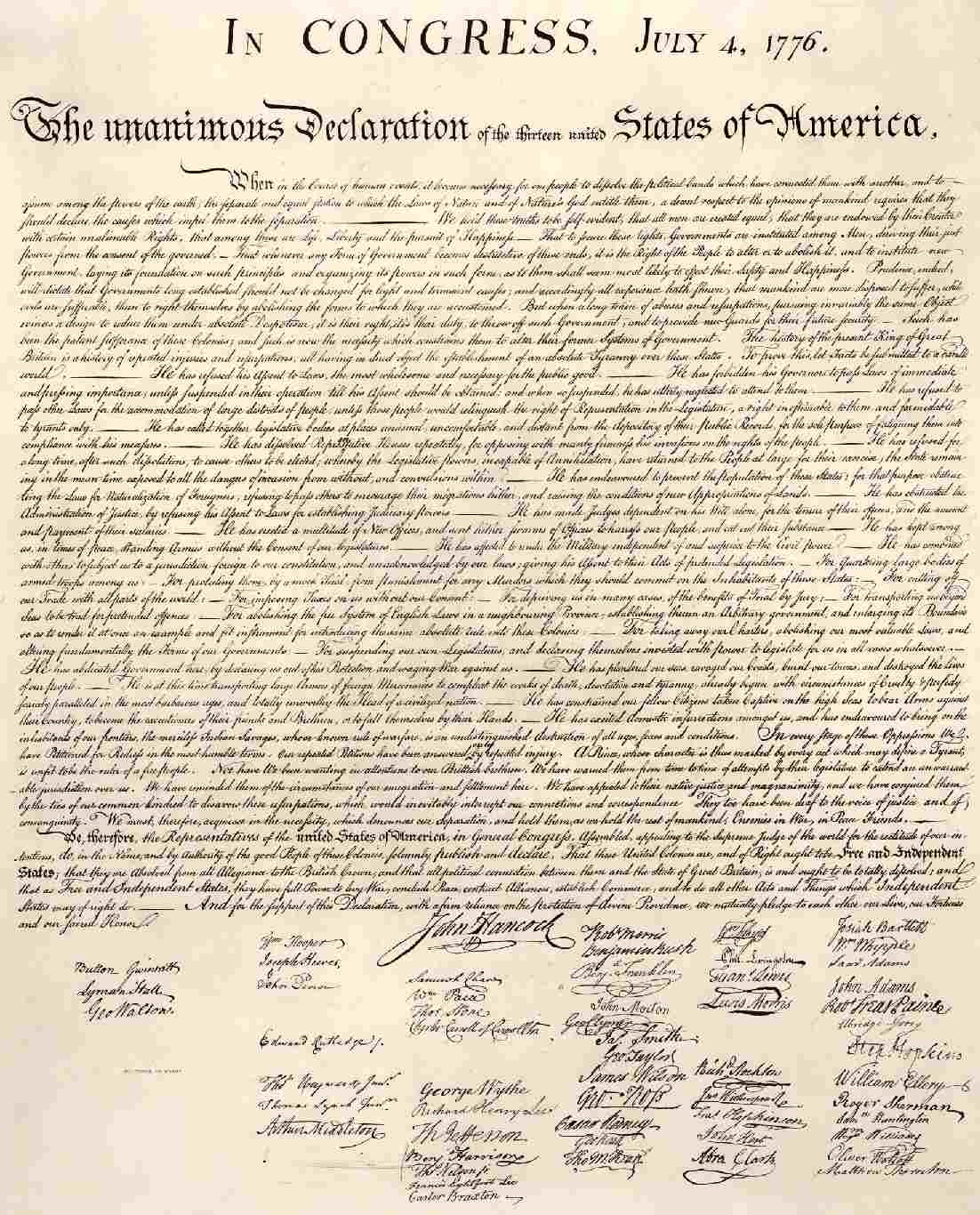
I'm a fan of Thomas Jefferson. He's not my favorite of the founders (that would have to be Washington), but his eloquence and the breadth of his interests--as well as his willingness to make a direct attack on the crust of religion that so often hides deeper truths--makes him one of the people I'd most wish to meet, if the chance ever arose.

Scientist, ambassador, author, naturalist, political theorist, inventor, bibliophile, president, architect, educator. Admittedly he was far from perfect, but that's still one hell of a resume. And now G.W.B. intends to celebrate the fourth with a speech from Monticello. It was Jefferson who wrote of the need for "a decent respect to the opinions of mankind." It was Jefferson who argued against allowing the suspension of habeus corpus at any time, for anyone--citizen or not. It was Jefferson who overturned the Alien and Sedition Acts (the great-grandparent of the so-called PATRIOT Act). It was Jefferson who declared that a free press without a government was preferable to a government without a free press. For G.W.B. to step on that site and try to cloak himself in the mantle of Jefferson is enough to make me ill.


16 May, 2008

When other people do your thinking for you

Let's take a look at edicts to recently come from authoritative religious scholars, shall we? The majority are from Islam--which, lacking a central authority, encourages a range of remarkably stupid edicts from charismatic leaders--but there's plenty of room for everyone. For more, see a list from Foreign Policy (1):

For one thing, Pokemon is evil. So says Saudi Arabia's highest religious authority. It has also been blamed for encouraging gambling (that nasty card game, I suppose), labeled a front for "international Zionism," identified as "demonic" (by the Catholic Church in Mexico), and condemned for promoting the theory of evolution, "a Jewish-Darwinist theory that conflicts with the truth about humans and with Islamic principles." I never did trust Pikuchu.


(1) July 2007

24 April, 2008

The value of "walk-ins" and the cost of intangibles

A reminder from the Cold War of how America's image as the "good guy" encouraged people to defy their government and risk execution in order to help the US. The full article is here.

JOHN Guilsher, the Central Intelligence Agency field
officer in Moscow who handled one of the West's greatest espionage
coups of the Cold War in the classic traditions of the spy trade,
has died of pancreatic cancer at his home in Arlington in the US.
He was 77.

The CIA almost blew its chance to recruit the specialist
engineer Adolf Tolkachev in the late 1970s, but once he had been
"landed", Guilsher's professionalism and bravery helped build a
bond that yielded military secrets of incalculable importance.

Tolkachev, a senior engineer for Phazotron, provided key details
of the research and development of the all-important radar systems
for the Soviet's front-line fighters from the MiG-29 and MiG-31 to
the Sukhoi Su-27, as well as for cruise missiles and avionics. His
secret revelations more than matched the importance of another
"volunteer" spy, Colonel Oleg Penkovsky of the Soviet military
intelligence service,who provided the CIA with key information in
1960.

HUMINT has never been a strong point for the US, if by that you mean the laborious job of identifying and running potential human agents. Some of the most important agents the US had were people who literally "walked in", often several times and after being rejected, with critical information.

It seems to me the Cold War was, at least in part, a war of ideas and a war of reputations. The US had tremendous advantages, especially after the brutality of the Soviet system grew too obvious to deny (except, perhaps, by the New York Times). Today we seem to assume that people see us as the good guys. At the same time we disappear people, support dictators, train paramilitaries, and act in ways--at home and abroad--that puts a lie to the rhetoric.

I'm not saying the US has to be beyond reproach. Foreign policy can get tough, and on occasion there is a need to kill people and break things. Most people understand that. But not like we have been. Going too far gives an advantage to people who should have nothing to offer. Even now, the best intelligence on adversaries comes from the locals who have come to see our common enemies as a common enemy. Soft power translates into, and supports, the more obvious instruments. Overall, we seem to be intent on throwing away our good reputation.


15 April, 2008

Welcome to the future

For a blast from the past, take a look at Popular Mechanics' forecast forty years into the future, to the year 2008:


You can check out the full article here. I for one, miss that future. What happened to it?

14 April, 2008

DHS surveillance

The Washington Post reports that DHS (1) is pushing "to start using the nation's most advanced spy technology for domestic purposes soon," despite opposition from Congressional Democrats.

I'm not sure what I should be more concerned about: that these idiots are going to have access to more advanced spying technology, or that this technology is in the hands of idiots. It's sad when the most redeeming feature of an administration is the possibility that they are too incompetent to take advantage of what the technology makes possible.

(1) The people that brought you the management of post-Katrina reconstruction.