14 July, 2008

Working as designed

An analyst of African affairs, cited by VOA, adds a note of reality to the most recent "failure to intervene" in Zimbabwe. A relevant section:

On Friday a UN Security Council draft resolution to impose sanctions on Zimbabwe was vetoed by both China and Russia. Zimbabwe’s information minister described the resolution as a Western plot and has welcomed its rejection.

UK Ambassador to the UN said the Security Council has failed the people of Zimbabwe.

However, reacting to the veto, Herman Hanekom, independent analyst of contemporary Africa said it was Russia and China that failed.

“I don’t think the Security Council as such failed. What failed was Russia which cannot really speak of a good human rights record, then there’s China which also failed…”

This is exactly what the Security Council was designed to do. It was intended to cloak joint actions by great powers with an air of respectability, while making sure that none of those powers would be able to act with UN authority in opposition to the will of the others. (They can still act--the veto protection will keep them free from Security Council interference--but not with the legal authority granted by the UN seal of approval.)

Now, you may not like how it works, but don't complain that the Security Council isn't doing its job. This is its job.

13 July, 2008

Don't leave home

You can understand the resistance of this administration to joining the International Criminal Court. It's not about protecting American soldiers, I suspect--it's about protecting themselves. As the days count down on this presidency, the talk of war crimes prosecutions is slowly growing larger. From a recent review:
Mr. Bush's 2005 proclamation that 'we do not torture' was long ago revealed as a lie. Antonio Taguba, the retired major general who investigated detainee abuse for the Army, concluded that 'there is no longer any doubt' that 'war crimes were committed.' Ms. Mayer uncovered another damning verdict: Red Cross investigators flatly told the C.I.A. last year that America was practicing torture and vulnerable to war-crimes charges.

Top Bush hands are starting to get sweaty about where they left their fingerprints. Scapegoating the rotten apples at the bottom of the military's barrel may not be a slam-dunk escape route from accountability anymore.

No wonder the former Rumsfeld capo, Douglas Feith, is trying to discredit a damaging interview he gave to the British lawyer Philippe Sands for another recent and essential book on what happened, 'Torture Team.' After Mr. Sands previewed his findings in the May issue of Vanity Fair, Mr. Feith protested he had been misquoted - apparently forgetting that Mr. Sands had taped the interview. Mr. Feith and Mr. Sands are scheduled to square off in a House hearing this Tuesday.

So hot is the speculation that war-crimes trials will eventually follow in foreign or international courts that Lawrence Wilkerson, Colin Powell's former chief of staff, has publicly advisedMr. Feith, Mr. Addington and Alberto Gonzales, among others, to 'never travel outside the U.S., except perhaps to Saudi Arabia and Israel.
Will these people be tried? Almost certainly not. Much like Nixon, those who come next will mostly likely decide the best thing for the country will be to pardon anyone and everyone who might be prosecuted. And while this is one of the situations the ICC was designed to handle--a country that refuses to investigate or prosecute the possible crimes of its leaders--I don't see any way to make it work.

Then again, I've been wrong before. Could a retired American official be picked up in international waters? Will one need some special medical treatment abroad? Will one be so arrogant that he ignores the possibility of his own arrest? Will some future president decide it's in his best interest to ship some of these people to the Hague? A presidential pardon can keep you out of an American courtroom, but it doesn't mean anything anywhere else. War crimes are subject to universal jurisdiction, with no statute of limitations.

The Saudis can't save us

Thanks, Fabius Maximus, for a pointer to a recent Business Week article on Saudi Oil production. The relevant excerpt:
It appears that for at least the next five years, and possibly longer, the Saudis are likely to produce less crude than promised, according to fresh data on the kingdom’s oil fields obtained July 9 by BusinessWeek. Saudi officials have said they
would increase production capacity to 12.5 million barrels a day next year, from the current 10 million barrels a day, and could even ramp up to as much as 15 million barrels a day if the market demanded it.


… But the detailed document, obtained from a person with access to Saudi oil officials, suggests that Saudi Aramco will be limited to sustained production of just 12 million barrels a day in 2010, and will be able to maintain that volume
only for short, temporary periods such as emergencies. Then it will scale back to a sustainable production level of about 10.4 million barrels a day, according to the data.


BusinessWeek obtained a field-by-field breakdown of estimated Saudi oil production from 2009 through 2013. It was provided by an oil industry executive who said he had confirmed it with a ranking Saudi energy official who has access to the field data. The executive, who has proven reliable over several years of reporting interaction, provided the data on condition of anonymity to protect his access to the kingdom and the identity of the inside contact who confirmed the information.
For several years now, it's seemed to me that there are no reasons for the Saudis (or anyone else in OPEC, for that matter) to provide a reliable estimate of their known or probable reserves. In OPEC--and in the world at large--what people believe your reserves to be are a source of power. Whether you actually have the oil is less important (in the short run, at least). So now we see people begging for increased production from people who, in all likelihood, couldn't deliver it even they wanted to.

Is this "peak oil"? It depends on what you mean by the term. If this knowledge (or perception) is getting around, however, it would make it even more sensible to engage in "speculation" in the oil markets. What do those "speculators" know (or think they know) that we don't?

Holding hostages

If the United Nations is serious about its engagement with Sudan, it should tell [Luis Moreno-Ocampo] to suspend what he is doing with this so-called indictment. There will be grave repercussions.

--Abdalmahmood Abdalhaleem Mohamad, Sudan's ambassador to the UN.

So what's the proper response? It's times like these I wish we had a competent "Team America" (or Team UN) to go after the bad guys.

Playing to tie

This fits with what I've seen elsewhere, as well as Freedman's recent analysis on Stratfor. I get it from the Security Framework Project. I wish people in authority would admit it, and let the public in on the secret:

I think we need to refocus our priorities on al-Qaeda, and al-Qaeda is
strongest in Afghanistan, and the border of Pakistan. We need to make
sure we're doing what's necessary to go after the person and the
organization that killed 3,000 innocent Americans back on 9-11 of 2001.
But I've talked to senior members of the Bush administration who have
told me, off the record, that we're playing for a tie in Afghanistan,
which is not acceptable in my view.

- Rep. Patrick Murphy, the only Iraq War veteran in Congress
Actually, I can see playing for a tie if you expect the opposition to fall apart on its own, but that doesn't seem to be the case this time.

More generally, much of what's wrong is we still don't identify the enemy, or our allies. While alliances are always imperfect, Pakistan barely even qualifies as an ally. Pakistan is not and never was a complete ally, because Pakistan is not and never was a complete country. At best, some elements in Pakistan have worked with the US (of elements thereof) on limited issues of mutual gain, or as a result of personal payoffs.

So long as there are safe havens for the enemy in Pakistan, as I suspect there will be for a long time to come, the US can't have a traditional military or political victory in Afghanistan.

Afghanistan has its own identity problems. The center of gravity in Afghanistan has never been the cities, and the sense of national identity has always been very weak. You can't defend someone who isn't really there.

So what's to do? We can (and sometimes do) play people against one another. We can (and sometimes do) develop good intelligence and act on it. We can (and sometimes do) maintain a dirty, invisible "war". We can declare a local "victory" and shift our military resources elsewhere.

Maybe I'm just tired today.

03 July, 2008

The scum rises to the surface


Two of my least favorite people--David Addington and John Yoo--appeared before the House Judiciary Committee last week, demonstrating why some people should never be allowed near the levers of power.


Rebels and the price of oil

John Robb, author of the Global Guerrillas blog and Brave New War, has been pointing to the Nigerian delta as a example of what can go wrong when a small, dedicated network takes on the vulnerabilities of the system of global oil production and transport. Now they are threatening the tankers, too. Threatening to disrupt supplies will have an effect on prices, of course. Beyond "speculation" (whatever that means in this context) the ability to disrupt supplies means any reasonable person has to add an insurance factor to cover possible losses. Even by existing, and making a credible threat, a terror group can shift the balance of supply and demand.

Moreover, they know it. Therefore, one indicator of a forthcoming act (an attack or a credible threat) may be that some local groups purchase oil futures, secure in their knowledge that they can drive the price up. It wouldn't be easy to find these signals, but I hope someone is looking for them. Even though it's not a new idea--protection rackets, anyone?--I hate the idea that some people are using terror to finance terror. One of the few good things about conventional war in the modern world is it is almost impossible to make a profit from fighting one. (Arms suppliers can profit, but the the purchasers seldom do.) But terror for megaprofit is a real possibility.

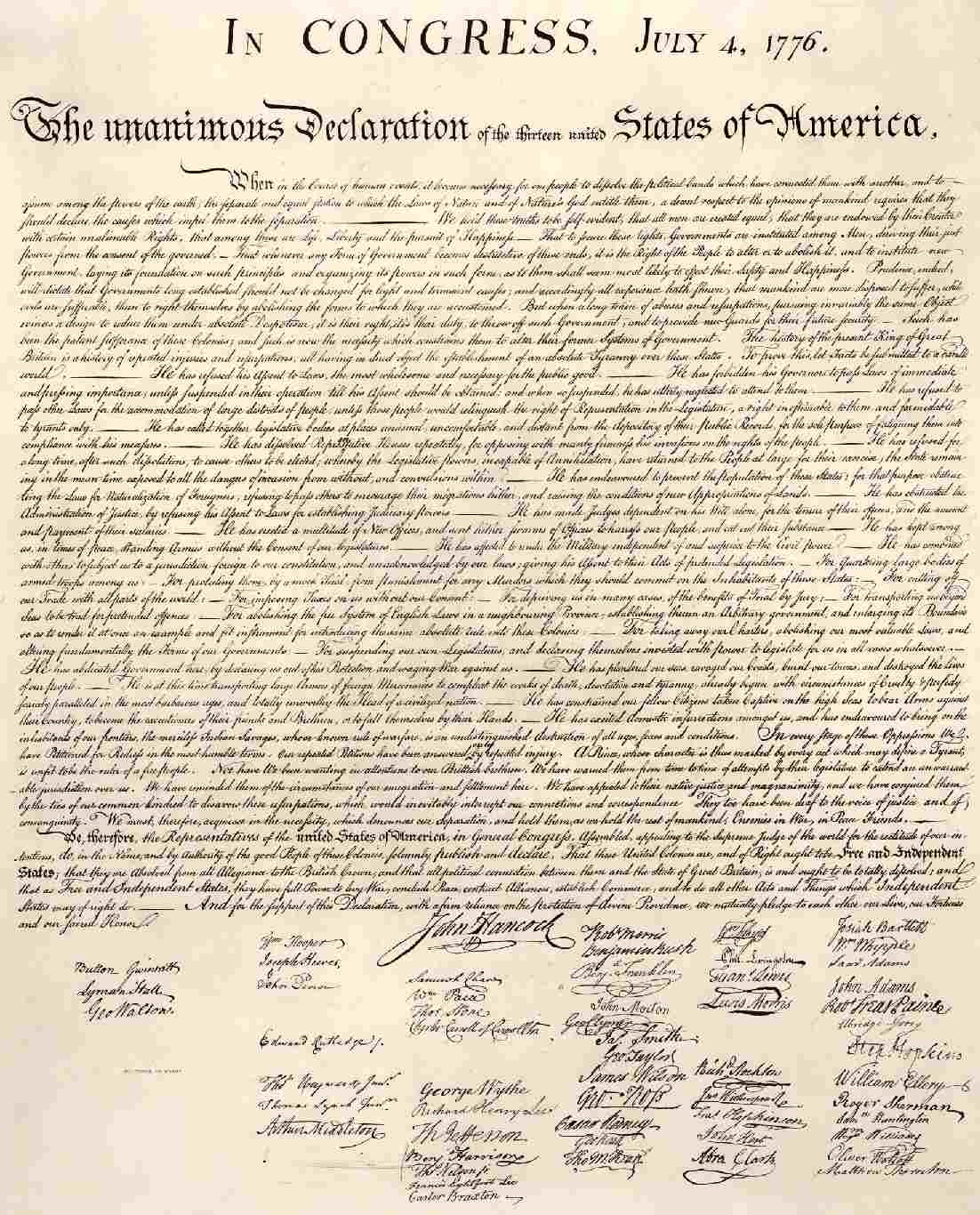
George W. Jefferson

I'm a fan of Thomas Jefferson. He's not my favorite of the founders (that would have to be Washington), but his eloquence and the breadth of his interests--as well as his willingness to make a direct attack on the crust of religion that so often hides deeper truths--makes him one of the people I'd most wish to meet, if the chance ever arose.

Scientist, ambassador, author, naturalist, political theorist, inventor, bibliophile, president, architect, educator. Admittedly he was far from perfect, but that's still one hell of a resume. And now G.W.B. intends to celebrate the fourth with a speech from Monticello. It was Jefferson who wrote of the need for "a decent respect to the opinions of mankind." It was Jefferson who argued against allowing the suspension of habeus corpus at any time, for anyone--citizen or not. It was Jefferson who overturned the Alien and Sedition Acts (the great-grandparent of the so-called PATRIOT Act). It was Jefferson who declared that a free press without a government was preferable to a government without a free press. For G.W.B. to step on that site and try to cloak himself in the mantle of Jefferson is enough to make me ill.


16 May, 2008

When other people do your thinking for you

Let's take a look at edicts to recently come from authoritative religious scholars, shall we? The majority are from Islam--which, lacking a central authority, encourages a range of remarkably stupid edicts from charismatic leaders--but there's plenty of room for everyone. For more, see a list from Foreign Policy (1):

For one thing, Pokemon is evil. So says Saudi Arabia's highest religious authority. It has also been blamed for encouraging gambling (that nasty card game, I suppose), labeled a front for "international Zionism," identified as "demonic" (by the Catholic Church in Mexico), and condemned for promoting the theory of evolution, "a Jewish-Darwinist theory that conflicts with the truth about humans and with Islamic principles." I never did trust Pikuchu.


(1) July 2007