Showing posts with label civil liberties. Show all posts

08 July, 2018

Torture (II)

A draft review of Manfred Nowak, Torture: An Expert's Confrontation with an Everyday Evil (Philadelphia: U of PA Press, 2018).  Translated from the German by Roger Kaminker.

The author was the UN Special Rapporteur for the Human Rights Council from 2004 to 2010.  He has also worked with the EU, universities, and NGOs to  investigate cases of torture, promote prosecutions of offenders, and improve conditions of detention.  Yet one of his first observations is that past all the definitions and descriptions of torture, "we cannot fully grasp its essence if we have never experienced it."  And while torture is universally condemned in international law, this direct attack on the essence of what it means to be human is used--"routinely"--by the police of most of the world's states.  The author hopes, by exploring the depths of the evil torture involves, to promote the sense of outrage prompted by the reporting on the Holocaust. Clearly, instruments of international law are not enough. He wants "a new global consensus to effectively eradicate torture."  I sense he will be waiting a long time.

Novak's description of the operations of the United Nations follows a familiar pattern: noble goals, undermined by state practice. Systematic cruelty is hidden behind a wall of lies.  So he describes how, as an investigator, he had to work under the rules promulgated by each state he was investigating. And he explores how it was possible, sometimes, to work within those rules and still learn something of value. Arranging confidential interviews and medical examinations was crucial.  When victims would describe, without police in the room, what had been done to them the evidence would almost always back up their stories. And these are the states that allowed interviews.  At some level, the officials of those states believed (or told themselves) it "wasn't so bad."  Or at the very least they thought they could whitewash the conditions sufficiently to get out of the international spotlight.  It says a lot that neither Russia or the United States would allow these interviews to take place.

The book is divided into two parts.  Part one is an overview of torture, inhuman detention, and other "cruel, inhuman, or degrading" treatment.  Despite the Convention, what counts as torture varies by region and culture. Corporal punishment and capital punishment? At the insistence of many Islamic states, the UN Convention against torture does not include pain or suffering arising from "lawful" sanctions. Like those who define "terrorism" as the act of a non-state, this is potentially a loophole that renders the Convention meaningless.  At the same time, if a state does not enact legislation (and enforce it) against private acts of dehumanizing violence, it endures as the norm.

Part two is a survey, chapter by chapter, of torture in individual states. These are based on Nowak's investigations, ranging from Georgia to Mongolia, Nepal to China, Jordan to Austria, he established torture had occurred in seventeen of eighteen states.  The only counterexample he found, Denmark, began with a very different model of what a prisoner is and what a prison is for.  A retributionist system must be replaced by one that sees the prisoner as a human being, with all the rights that involves,working to integrate himself back into the community. We have a long way to go.

25 November, 2017

I've heard of the parasitic state, but this is beyond merely "evil"

A North Korean soldier recently escaped across the DMZ.  He was shot six times by his comrades before he reached safety.  But his new wounds were the least of his troubles:
Along with the bullet wounds, he also had hepatitis B, pneumonia and “an enormous number” of parasitic worms in his intestines, some up to 11 inches long. “I’ve never seen anything like this in my 20 years as a physician,” said his South Korean surgeon. The worms can burrow into fresh wounds, with potentially devastating effects.
And remember, this was a soldier, quite possibly one trusted enough to help guard the Demilitarized Zone.  There's no way he was from an "hostile" caste:
Every one of North Korea’s 23 million people is subject to the brutal state-imposed caste system known as songbun. The word “songbun” should be notorious around the world. From birth, every North Korean is marked by the government as a member of a loyal “core” caste, a “wavering” middle caste or a “hostile” caste, and this designation determines access to food, housing, education, jobs — everything. During the famine of the 1990s, when more than two million North Koreans perished, the songbun system often determined who ate and who starved.
If this is what life is like for him, what is it like for the others?

I'm not calling for war, especially with North Korea.  It's not my place to be judge and executioner.  But it seems to me there are a lot of people in North Korea who deserve to die.  Economic sanctions?  That'll only hurt the innocent.  Assassination?   The people who deserve it are so hard to get, and so well protected.  Perhaps, like the French Resistance, we can air-drop thousands of cheap, one-shot handguns on the territories of the prison farms, momentarily giving some of the victims a chance to fight back.  But it wouldn't hurt the top, and it might trigger a war.

So how about thinking slightly outside of the box?  There has been talk of "ethno-weapons" for several years now, but there isn't enough genetic diversity in the Korean population to target only the monsters.  Could someone develop a weapon that sickens only the well-fed, or the obese?  Or a weapon tailored to a specific target?  In 2012 The Atlantic reported on the progress made in engineering bioweapons tailored to a specific person's DNA.  It seems the US has been collecting the DNA of world leaders for years, and recently Russia has lodged protests at what they claim are American attempts to collect Russian DNA.  If some other stories are true, there is an attempt by the Secret Service to collect and dispose of everything touched by the president, in order to reduce his vulnerability to a tailored attack.  I can't see how that can work, however, even for a germophobe like Trump.

So how about something tailored to Kim Jong Un?  Or his family?  I don't have the capability to do it, but with the availability of genetic technology increasing, and the price dropping, it's probably only a matter of time before some smart kid engineers biological viruses.  Like computer viruses, it may be a problem too pretty to not hack.  And today, governments can already do much, much more.

Again, I'm simply thinking aloud.  Even if I could do it, I wouldn't.  But BioAnonamous, are you listening?

The Parasites Feeding on North Koreans - The New York Times

Hacking the President's DNA 

15 December, 2012

The all-seeing government

Elements of the US government assume everyone is a terrorist, and has authority to mine every data base associated with, or accessed by, the government as a whole to maintain surveillance on everyone's behavior, looking for (as yet unannounced) "suspicious patterns" and making predictions of future activity.

united states currency eye- IMG_7364_web
united states currency eye- IMG_7364_web (Photo credit: kevindean)
After the somewhat-farcical (and some claim, contrived) case of the "underwear bomber"the National Counterterrorism Center (NCTC--leave it to the government to misspell an acronym) requested to maintain a dragnet that made even the Department of Homeland Security uneasy.  After long insider arguments, the Wall Street Journal Reports, that access was granted in March of this year.

According to the DHS privacy officer this a "sea change" in which the first question to be asked by the feds of any citizen is now "are they a terrorist?"  The legislative counsel of the ACLU describes it like this:

What if a government spy agency had power to copy and data mine information about ordinary Americans from any government database? This could include records from law enforcement investigations, health information, employment history, travel and student records. Literally anything the government collects would be fair game, and the original agency in charge of protecting the privacy of those records would have little say over whether this happened, or what the spy agency did with the information afterward. What if that spy agency could add commercial information, anything it – or any other federal agency – could buy from the huge data aggregators that are monitoring our every move? 
What if it wasn’t just collection but also sharing? Anything that was reasonably believed to be necessary to “protect the safety or security of persons, property or organizations” or “protect against or prevent a crime or threat to national security” could be shared. Imagine the dissemination was essentially unlimited, not just to federal, state, local or foreign governments but also to individuals or entities that are not part of the government 
It has already happened.
And almost no one seems to care. Even working on the assumption that the motives of everyone involved in this are pure, it's setting up a weapon in the name of national security aimed not at "the terrorists," but at everyone.  In fact, if anyone would be safe from this it would be a skilled terrorist. It shines the light on the trivial at the expense of what might actually be useful, if the system were focused and operated in keeping with constitutional safeguards.  It promises predictability.  It delivers chaos.  And in the meantime, it places whatever data exists--whether true or not--combined and analyzed by whatever algorithm is applied--however imperfect or biased--into the hands of politicians and bureaucrats--no matter how stupid or evil--to do with as they will.

Who needs terrorists?  Who nees to look outside for threats?  They don't: they have us.  And we don't: we have them.


US Counterterrorism Agency Collects Data On Every US Citizen - Business Insider

17 July, 2012

Stuxnet and Flame

Depiction of a compartmented "Behind the ...
Depiction of a compartmented "Behind the Green Door" US secure communications center (Photo credit: Wikipedia)
Cyberwarfare is getting interesting, and not just because of what it means for "traditional" international relations.  Increasingly, it looks like anyone can run a serious cyber-espionage operation.  How long until these tools are in the hands of more non-state actors?  When do they become a major tool in domestic politics?  IntelNews reviews the situation.  Excerpts:
Stuxnet, which caused unprecedented waves of panic among Iranian cybersecurity experts, was 500 kilobytes in size. Flame is over 20 megabytes in size, consisting of 650,000 lines of code; it is so complex that it is expected to take programming analysts around a decade to fully comprehend. The two are different, of course. Stuxnet was an infrastructure-sabotaging malware, which destroyed hundreds —maybe even thousands—of Iranian nuclear centrifuges. Flame, on the other hand, appears to be an espionage tool: it aims to surreptitiously collect information from infected systems.
Both, of course, were directed against Iran.  But they don't end there.
...there is no little doubt that Flame’s handlers have collected massive amounts of intelligence for at least two years. The program was apparently able to record conversations conducted over Skype; take desktop snapshots every 15 seconds or so; and collect usernames and passwords, among other capabilities. And all that while circumventing even the strongest antivirus software. But there is also the other side of the equation: as in the case of Stuxnet, Flame is now effectively freeware. Anyone can ostensibly access it, copy it, modify it, and re-launch it against his or her target of choice...
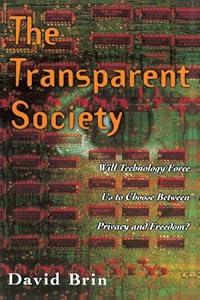
Cover of "The Transparent Society: Will T...
Cover via Amazon
Over 100 Israeli systems are already reported to have been infected by Flame, as well as systems in several other countries in the region.  The United States?  I have found no conclusive reports one way or another.  And even then, we'd have to distinguish between government and corporate and other systems.  But the "freeware" aspect intrigues me.  How much trouble would it be for the next PFC Manning to insert a version of Flame into SIPRNet?  Or something more restricted?  I can't help but wonder how many cyberactivsts are pouring over the code.

Are we approaching the land of "No More Secrets"?  Is this The Transparent Society discussed by Brin?  Not really, if only for the reason that those who uncover secrets may not be able to understand what they have, or may choose not to share it with the world.  But it does raise the prospect that while the NSA plugs away at monitoring everything we do, there might be a lot more states and non-state actors doing the same to them.  How will that change the game?

Comment: Who authored computer virus that ‘dwarfs Stuxnet’? « intelNews.org

12 June, 2012

The US in context: we're number eighty-eight!

 There's Global Peace Index each year, calculated by the Institute for Economics and Peace on the basis of
...23 indicators, ranging from a nation’s level of military expenditure to its relations with neighbouring countries and the level of respect for human rights. The index has been tested against a range of potential “drivers” or determinants of peace—including levels of democracy and transparency, education and material wellbeing. The team has used the latest available figures from a wide range of respected sources, including the International Institute of Strategic Studies, The World Bank, various UN entities, Peace Institutes and the Economist Intelligence Unit.
So where's the US?  Number 88 out of 153, between Equatorial Guinea and China.  (Within the US the most peaceful state is Maine and the least is Louisiana.)  Key factors bringing down the rating for the US are deaths in foreign wars, percent of population in prison, access to weapons, political terror, and weapons exports.  On the bright side, violent crime is low, and so is political instability.  Here's the map:
So it could be worse--but I can't say I'm proud of the company we keep.

Global peace index 2012: the full list | News | guardian.co.uk
Enhanced by Zemanta

04 June, 2012

The FBI: Bringing more and bigger terrorism to you

The New York Times estimates that of the "22 most frightening plans for attacks since 9/11 on American soil, 14 were developed in sting operations."  This may be conservative--but we can use it as a minimum standard for analysis.  And what do these stings look like?

THE informer, Shahed Hussain, had been charged with fraud, but avoided prison and deportation by working undercover in another investigation. He was being paid by the F.B.I. to pose as a wealthy Pakistani with ties to Jaish-e-Mohammed, a terrorist group that Mr. Cromitie apparently had never heard of before they met by chance in the parking lot of a mosque. 
“Brother, did you ever try to do anything for the cause of Islam?” Mr. Hussain asked at one point.“O.K., brother,” Mr. Cromitie replied warily, “where you going with this, brother?” 
Two days later, the informer told him, “Allah has more work for you to do,” and added, “Revelation is going to come in your dreams that you have to do this thing, O.K.?” About 15 minutes later, Mr. Hussain proposed the idea of using missiles, saying he could get them in a container from China. Mr. Cromitie laughed. 
Reading hundreds of pages of transcripts of the recorded conversations is like looking at the inkblots of a Rorschach test. Patterns of willingness and hesitation overlap and merge. “I don’t want anyone to get hurt,” Mr. Cromitie said, and then explained that he meant women and children. “I don’t care if it’s a whole synagogue of men.” It took 11 months of meandering discussion and a promise of $250,000 to lead him, with three co-conspirators he recruited, to plant fake bombs at two Riverdale synagogues. 
“Only the government could have made a ‘terrorist’ out of Mr. Cromitie, whose buffoonery is positively Shakespearean in its scope,” said Judge Colleen McMahon, sentencing him to 25 years. She branded it a “fantasy terror operation” but called his attempt “beyond despicable” and rejected his claim of entrapment.

There are real terrorists, but not enough to justify the expense and systematic loss of liberty associated with the "war on terror."*  How many "terrorists" are incompetent losers looking for a cause to latch on to, pushed by government agents to commit acts which will, when "uncovered," build budgets and careers?  

13 March, 2012

Yet another case of overreaction

The governor of Virginia recently signed legislation which required an ultrasound--in almost all cases by vaginal probe (although the text of the legislation is careful to obscure that)--for any woman who has a abortion.  This is in spite of her desires, or those of her doctor.  Whatever you think of abortion, this is a clear violation of any principle of self-ownership.  So I suppose we shouldn't be surprised when (a) people protested, and (b) a state which has no regard for people in any case called out the storm troopers.
At least it made for some visuals, courtesy of http://militantlibertarian.org and Style Weekly.

 
Now all they need is a tank.
Enhanced by Zemanta

09 March, 2012

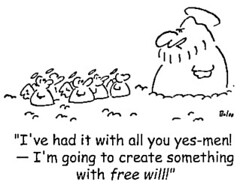
Does Liberty require free will?

Is there "free will" in heaven? What...
Is there "free will" in heaven? What about "free will" in life?
 (Photo credit: Zombie Inc. Wholesale Zombies for Over 25 years)
Ah, the eternal question.  Expressing an opinion affirming existence of free will, as a recent article in the Economist's sister magazine, Intelligent Life does, is to open the floodgates of dogmatism.  That can be fun, and a bit mind-stretching, but often seems to deteriorate into a "conversation" where people are actually talking past one another.  Yet political philosophers--especially libertarians--seem to need some kind of assumption of moral agency for their speculations to have meaning.  How can it make sense to talk about "liberty" if humans have no capacity for independent choice?

Does it even matter?  If to feel that one is free is to be free, isn't that enough?  That leads us down some dark paths.  Brains can be manipulated, and so can perceptions.  As the technologies of social control grow more effective, it's conceivable to live as a community of happy robots, each convinvced it is free, each acting according to plan.

The more we look, the more the philosophy--and the language--get in the way.  For one thing, what is "free will"?  Does it mean an "uncaused cause," or "a nonlocal thought," or is it simply the sense that we feel we weigh and struggle with alternatives before committing to a course of action?  Perhaps the best definition I've seen comes from the comments to the aformentioned article:
A biological or AI system has free will if its future behavior cannot be predicted solely by observing its past behaviour or external communications. A stronger definition would require inability to make such prections regardless of the methods used (eg deep scans of arbitratry complexity of the brain/system). I suspect humans have free will only in the first form of this definition, though for now there probably exists no technology to refute free will of the stronger kind either. (Thomas Anantharaman).
Or how about this one?  Also from the same comments section:
While recognizing the logic of determinism, I choose (?) to invoke "freedom for all practical purposes," meaning behavior that cannot be predicted and anticipated by another agent is effectively free. The brain and its behavior are sufficiently complex that it takes as much or more effort to predict and thereby control it as to "live" it. And that means we are all practically free and that no one has the ability to control others without incurring a high cost. A sufficiently complex machine would become as free as we are, if it took more effort to control it than that effort was worth in economic terms. (Thomas Earle Moore)
The no free-will bus campaign
The no free-will bus campaign (Photo credit: morgantj)
Perhaps the best we can hope for is to be too complex to predict, too complex to plan, too complex for outsiders to control.  If that is happening, and I have the occasional power to self-modify my own habits of action and mind, that's good enough for me.  And it's more than valuable enough to preserve.  While a free will does not require a free society, a free society implies the possibility of free will.

NEURONS V FREE WILL | More Intelligent Life

28 February, 2012

Clearing my desk

WASHINGTON - OCTOBER 28:  U.S. Attorney Genera...
Eric Holder at the signing of the NDAA by Getty Images via @daylife

It's been too long since I posted here, so I'll start by clearing up a few "must reads":

(1) The NDAA Makes it Harder to Fight Terrorism | Foreign Affairs: Brian Michael Jenkins is one the world's greatest experts on international terrorism. He started the RAND Corporation research program on terrorism in 1972. (Where were you in 1972?) When he points out that the liberty-stripping provisions of the National Defense Authorization Act will do nothing to facilitate the prosecution of the war on terrorism, and will in fact harm it, all I can add is "amen". But then he adds something I hadn't thought of. The Authorization for the Use of Military Force Resolution is the post-9/11 act authorizes the use of force to kill or capture those responsible for 9/11 and to prevent future international terrorist attacks. The NDAA allows the detention of terrorist suspects "until the end of hostilities," as authorized by the AUMF. Assuming there is no official statement that the war is "forever" there will come a time when

the United States will consider its military mission against terrorism to be over. Declaring an end to the military campaign, however, would remove the country's legal basis to hold enemy combatants. Pressure would increase to release detainees. While lawyers and legislators try to work out the ambiguous post-hostilities status of detainees, those convicted of crimes in civilian courts will remain locked away in jail, serving out fair sentences.
I might add that as time passes the question of whether the military mission is "over" will itself become a political question. Already combat pay is being cut for soldiers in Afghanistan. There will be a political bonus for the politician who can claim the "victory" of transforming terrorism from a war back to a normal security problem. (Of course, there will also be those whose jobs and identity are so wrapped up in the current definition of the situation that they'll resist that declaration.) I shudder to think of the question of when a military action "ends" being fought through the federal courts. And even before the issue is settled, there will be lawyers using the ambiguity to call for the release of real mass murderers.

Meanwhile, the people locked up who have nothing to do with terrorism--the majority, I expect, if the history of the (s0-called) PATRIOT Act is any indication--will probably be the last to get out.

Legal rules exist for a reason. Tampering with them on the spur of the moment--by legislators or by courts--rarely serves the interests of the people. It might help some prosecutors in the short run. It might help some politicians win reelection. But that's their problem. Mine is to keep them from screwing with the rights of the rest of us.

(2) The Pentagon Discloses Military Intelligence Budget Request | Secrecy News: It's 19.2 billion dollars, and that's a drop from the high. It looks like winding down the wars is the primary reason for the decline. And for once, the DoDers (DoDoes?) weren't forced to release the secret. It was just there, in the request, because the relevant Defense Department authorities changed their minds on the need for classification.

There actually is some intelligent life in D.C.

I hope it doesn't harm their careers.

(3) A New Perspective on Cost of War from the folks at Demon*cracy.


The original graphic is huge. You really need to see the original to get the full impact.

Now, if we could just estimate the cost of not going to war we could do a cost-benefit analysis. My suspicion is it wasn't worth it--not this long, not this much, and not at all for Iraq. Whether or not you think the price was worth it, it's clear the price--the immediate price, not counting what it has done to our society and law and politics and economy in the long run--has been huge.

27 January, 2012

It's for your own good

Department of Homeland Security
Image by DonkeyHotey via Flickr
Yeah, right.

A recent Freedom of Information  Act suit by the Electronic Privacy Information Center reveals some of the fun the Department of Homeland Security has been having in the name of "protecting" us--or whoever they think they're protecting.  According to the findings

...the DHS has hired and instructed General Dynamics to monitor political dissent and the dissenters. The range of websites listed as being monitored is quite impressive...
***
Some of the more high profile and highly trafficked sites being monitored include the comments sections of The New York Times, The Los Angeles Times, Newsweek, the Huffington Post, the Drudge Report, Wired, and ABC News. In addition, social networking sites Facebook, MySpace and Twitter are being monitored. For the first time, the public not only has an idea who the DHS is pursuing with their surveillance and where, but what they are looking for as well. General Dynamics contract requires them to “[identify] media reports that reflect adversely on the U.S. Government, DHS, or prevent, protect, respond government activities.” The DHS also instructed General Dynamics to generate “reports on DHS, Components, and other Federal Agencies: positive and negative reports on FEMA, CIA, CBP, ICE, etc. as well as organizations outside the DHS.” In other words, the DHS wants to know who you are if you say anything critical about the government.
You better watch out, you better not cry.  They know when you've been sleeping, they know when you're awake.  They know if you've been "bad" or "good" (by their definition), so be good for goodness sake.


Enhanced by Zemanta

17 January, 2012

A small step in the right direction

Secretary of Defense Donald Rumsfeld shares a ...
Image via Wikipedia
I have a dream.

I have a dream where Dick Cheney and Donald Rumsfeld and George Bush are in cages, tried for war crimes, crimes against humanity, and violations of the Bill of Rights.

I'd prefer to see it in an American court. I'd like to think we can police our own, and only an American court can handle Constitutional violations. But I'd be willing to accept handing them over to the International Criminal Court. Perhaps a combined trial with the remaining leadership of Al Qaeda.

If it's the best we can do, I'd even accept a Truth and Reconciliation Commission, similar to that after Apartheid in South Africa. At least then we could get the truth out, shame those who thought they cold hide their crimes, and build a consensus to never do it again.

Meanwhile, I have to settle for whatever small steps are made. One of these is a recent report by the World Organization for Human Rights and the Washington College of Law at American University. It's entitled INDEFENSIBLE: A Reference for Prosecuting Torture and Other Felonies Committed By U.S. Officials Following September 11th, and it does a solid job of starting to make the case for the prosecution. From the Table of Contents:
II. The Attorney General Has the Authority to Appoint Special Counsel to Investigate and, Where Warranted, Prosecute Crimes Committed by United States Government Officials.... 20
A. Department of Justice Regulations grant the Attorney General authority to appoint Special Counsel............................................................................. 20
B. The Attorney General also has the power to delegate broad authority to a special prosecutor pursuant to the U.S. Code. ........................................... 32
C. Where the subject matter of the investigation could raise serious conflict of interest issues pertaining to the DOJ, the DOJ regulations should be invoked as the appropriate source of authority for appointing Special Counsel ............. 36
III. The Orchestrated Effort by Former Top-Level Administration Officials to Implement a Detainee Interrogation Program Resulted in the Widespread, Systematic, and Unlawful Abuse and Torture of Detainees ......................... 38
A. High-ranking members of the Bush Administration issued policies or directives
authorizing detainee abuse ................................................................ 39
B. Senior-level U.S. government officials set out to create a legal framework that would justify the use of unlawful interrogation tactics against detainees.......... 48
C. The policies and directives issued by top U.S. government officials authorizing specific interrogation tactics were the direct cause of detainee torture, and cruel, inhuman, or degrading treatment...................................................................82
IV. High-Ranking U.S. Government Officials Violated U.S. Domestic and International Law by Approving or Facilitating the Use of Torture and Other Forms of Human Rights ViolationsAgainst Terror Suspects ........................114
A. Top U.S. officials unlawfully conspired, facilitated, and directed the commission of torture and other human rights violations in violation of international law......................114
B. Top U.S. officials may also be held criminally accountable for contributing to, or conspiring to commit, crimes in violation of other U.S. federal criminal laws ...................... 117
C. Bush Administration officials conspired to violate the Torture Act by agreeing to, forming, and implementing policies and procedures detailing and recommending acts violating the Torture Act ........................................... 140
D. Officials who have either aided, commanded, or counseled for the commission of felonies, or who conspired to do the same, may be prosecuted in U.S. courts under 18 U.S.C. § 2 and 18 U.S.C. § 371 ...................................... 156
E. No legal defense may be raised that would preclude investigation or prosecution of individuals who approved or facilitated the commission of torture ..................................... 228
V. Conclusion....................................................240
Maybe I'll use this for my UN and Law class. Have them try the case?

People's Blog for the Constitution » Report calls for prosecution of top government officials for acts of torture

03 January, 2012

One empire down, one to go?


Here's an interesting perspective on where we've been and where we're going, as articulated by Monika Halan:
The fracturing post-World War II equations showed through the plaster in 2011. The 63-year period from 1945 to 2008 will be remembered as the time when two dominant ideas about people and money, and how we choose to organize ourselves around these ideologies, died. One version delinked people from money; the other put money before people. The first collapse was in 1991 when the dominant interpretation of collectivism shattered the Soviet Union into 15 shards. The classless, moneyless, stateless, egalitarian society, which took from each according to his ability and gave to each according to his need, crumbled under the weight of authority and effort that was needed to impose something so state-centric and unnatural in place. Progress does get measured by money, and the severe scarcities and the dysfunctional economies of the Soviet bloc hastened the collapse—the delinking of people and money did not hold true. 
But handing over the keys to the market caused another collapse, and 2008 was when the interpretation of individualism in the form of predatory capitalism began its death dirge when the US’ financial sector demonstrated what unregulated greed can do. This version of capitalism (which was not what Adam Smith envisaged) delinked risk from reward, made a section of labour behave like capital, and made governments subordinate to the transnational corporation. That version of capitalism, emboldened by the breakdown of communism, pushed for and got what were called “free” markets and “less” government. But markets, as was later found out, were not really free—but compromised by the 1% who held the levers of control to move the system. And move it they did, towards appropriating more and more for themselves.
But there's more to it than that: both post-war empires overextended themselves. The Soviets couldn't pull back and manage a real "restructuring" (perestroika) and failed to keep "openness" (glasnost') under sufficient control to keep the empire intact. Today, with greater technologies for information transparency--and heavy-handed attempts to restrict it--the parallels for the US are too close for comfort. Do we really think the TSA is just for the external threat?

And then there's the Chinese. The Chinese government is watching the various "Springs" of recent history and finding it's too vulnerable for comfort. Little noticed in the growth of Chinese military power is the fact that the internal security forces now have a budget that rivals that of the PLA.

Old patterns of social organization and control are breaking down, but there's no consensus on what will replace them. Probably the best we can do is encourage experimentation, and see what works (and for whom) in various circumstances. But that's precisely what those in power are most opposed to trying. This could get interesting.

Liberty, Equality, Fraternity - Home - livemint.com

02 January, 2012

Why I am not a "big-L" libertarian

The short answer: for the same reason I'm not an anarchist, or a communist, or whatever--I don't trust absolute principles.

The long answer is articulated by nobel-prize winning economist Ronald Coase in a classic interview:

Reason: Though you are now known as a leading free market economist, you started your intellectual career as a socialist. Why and when did your political views change? 
Coase: They changed gradually. What was most important was the work I did on the economics of public utilities at the London School of Economics. I studied the results of municipal operation of utilities and the effects of nationalization, particularly in the post office. This led to grave doubts about nationalization. It didn't produce the results people said it did. My views have always been driven by factual investigations. I've never started off--this is perhaps why I'm not a libertarian--with the idea that a human being has certain rights. I ask, "What are the rights which produce certain results?" I'm thinking in terms of production, the lives of people, standard of living, and so on. It has always been a factual business with me. I discovered that municipal operation didn't work as well as people said it would, and nationalization did not either. 
Reason: You said you're not a libertarian. What do you consider your politics to be? 
Coase: I really don't know. I don't reject any policy without considering what its results are. If someone says there's going to be regulation, I don't say that regulation will be bad. Let's see. What we discover is that most regulation does produce, or has produced in recent times, a worse result. But I wouldn't like to say that all regulation would have this effect because one can think of circumstances in which it doesn't. 
Reason: Can you give us an example of what you consider to be a good regulation and then an example of what you consider to be a not-so-good regulation? 
Coase: This is a very interesting question because one can't give an answer to it. When I was editor ofThe Journal of Law and Economics, we published a whole series of studies of regulation and its effects. Almost all the studies--perhaps all the studies--suggested that the results of regulation had been bad, that the prices were higher, that the product was worse adapted to the needs of consumers, than it otherwise would have been. I was not willing to accept the view that all regulation was bound to produce these results. Therefore, what was my explanation for the results we had? I argued that the most probable explanation was that the government now operates on such a massive scale that it had reached the stage of what economists call negative marginal returns. Anything additional it does, it messes up. But that doesn't mean that if we reduce the size of government considerably, we wouldn't find then that there were some activities it did well. Until we reduce the size of government, we won't know what they are.

(Thanks to Virginia Postrel for reminding me of this interview.)

It's about estimating and observing consequences, within the context of an ethical framework.  What is the right end to achieve, and how do you avoid a means whose anticipated and unanticipated consequences are worse than the original problem you want to solve? Today, in an era of "negative marginal returns," large-scale government action often (usually) makes things worse.  But not always.

Thus, when I hear Ron Paul talk about reducing America's military presence around the world, I think he's on the right track.  I'm willing to be persuaded otherwise, but the knee-jerk interventionism of the past sixty or so years doesn't seem to be supported by the evidence.  When he talks about ending trade treaties, I want to learn what he'll replace them with.  The world is too interdependent for economic artarky.  International law and organizations have emerged, piecemeal for the most part, because they meet a need.  When he talks about removing all social safety nets, even for catastrophic and random events, he sounds wrong both morally and economically.

The big-L Libertarian Party bills itself as the "party of principle," and I admire that.  I also fear it.  The Bolsheviks were a "party of principle," too.  When political principles become so absolute that they get in the  way of observing and thinking and adapting to change, it's time to rethink the principles.

30 December, 2011

How bad is it?


Porter Stansbury, already noted for his gloomy predictions about the American economy, finds "the numbers tell us America is in decline... if not outright collapse."  His analysis starts with an estimate of real per capita GDP/time, based on a market-basket of currencies and/or gold.  Even this has pitfalls.  But, anyway, he uses a commodity index (the CRB) until 1975, and after the US is off the gold standard he switches to gold, and the chart looks like this:

I don't know that this is the best way to estimate what is going on, but clearly something is.  And this misses what may be the greatest problem of all: that per capita GDP tells us nothing about the distribution of wealth.  Things got better, it seems, in the years from Reagan to George W. Bush--but how much of that was consolidated in the hands of a few?  Even ignoring that, however, after 2001 things look bad for almost everyone.

Why bring this up here?  Because economic failure promotes desperation, and crime, and a police state mentality.

Stansbury connects the decline to an ethic of entitlement, coupled with vast (and unpunished) corruption at the top.  Henry Paulson and Tim Geitner should be behind bars for lying to Congress and providing more accurate insider information to old associates.  Congress doesn't do anything about it (perhaps because the Congress as a whole has an ever-widening gap with their consitutents, based in part on their exemption from insider-trading laws).

He also wants to claim that there's a direct correspondence to the Great Society programs, either by design (to buy off troublesome groups) or error (the basic errors of large-scale government planning systems).  That's debateable, but what isn't in doubt are the numbers--and the spiral of poverty and crime and incarceration they represent.  Some data points, again from Stansbury:

According to the NAACP, Texas taxpayers spent $175 million in 2009 to imprison residents from a small part of Houston – only 10 zip codes out of 75. Thus, people from neighborhoods that are home to only about 10% of the city's population account for more than 33% of the state's entire $500 million annual prison spending. These neighborhoods are overwhelmingly poor and African American. 
In Pennsylvania, taxpayers will spend $290 million in 2009 to imprison residents from just 11 of Philadelphia's neighborhoods, representing about 25% of the city population. On this relatively small urban area, the state will spend roughly half its $500 million prison budget. These neighborhoods are overwhelmingly poor and African American. 
In New York, taxpayers will spend $539 million to imprison residents from only 24 of New York City's 200 different neighborhoods. Only 16% of the city's population lives in these areas, but they will account for nearly half of the state's $1.1 billion prison budget. These neighborhoods are overwhelmingly poor and African American.

This is not about race, or at least not only about race.  In Detroit, where twenty-seven percent of African-American males graduate from high school, only nineteen percent of white males do so.  In practical terms, in an economy that's increasingly technical and global, these people have little or no chance.

My dad used to be a principal in the schools of St. Louis.  Eventually, he ended up in charge of the school for incarcerated minors.  I'm not sure what's worse: that he found that to be one of his safer assignments, or the fact that some of his students would commit crimes to get off the streets and return to the relative safely of his school.

Today, this country has more than seven million people in prison or on parole, more that any other industrialized state.  The prison population has grown from less than half a million people to more than 2.5 million today--and the building and running of prisons has become a profitable growth industry.  What does that say about us?

Stansbury identifies villians: democrats, republicans, government employee unions, big business.  I don't agree with all of his analysis.  But it's worth a look at the start of what is likely to be a very, very difficult year.