Showing posts with label future. Show all posts

26 November, 2017

If this goes on

It's relatively easy to anticipate first-order effects.  It's harder to anticipate second-order effects.  It's harder still to anticipate the interactions of second-order effects (and so on).  Maybe we'll eventually have an improved Watson to use as a tool to guess where we are going, but I doubt it.  The act of guessing, and acting on those guesses, changes the system.  That's why speculative fiction, especially dystopian literature, is useful: it helps one to anticipate and avoid some of the bad possibilities.  But even that, by insisting on a minimal "realism" will fail to catch black swans.  And if it does, nobody will believe them until the very last moment.


In that light, take a look at some speculations from the head of Daimler-Benz.  In his limited area, I think he's getting some of the first-order effects, and maybe a few of the second-order effects.  But assuming it doesn't all fall apart (always a not trivial assumption) we can figure he's missing ninety percent of what's going to happen.  And he fails to consider the political and social pushback.  So a few good rules for thinking about the future:
  1. The next year isn't going to change as much as you hope it will.
  2. The next five years isn't going to change as much as you think it will.
  3. The next twenty years will change more than you can imagine.
THIS IS WHERE WE ARE GOING | Follow The Money

P.S. If anyone has the original source, I'd like to see it.

25 November, 2017

I've heard of the parasitic state, but this is beyond merely "evil"

A North Korean soldier recently escaped across the DMZ.  He was shot six times by his comrades before he reached safety.  But his new wounds were the least of his troubles:
Along with the bullet wounds, he also had hepatitis B, pneumonia and “an enormous number” of parasitic worms in his intestines, some up to 11 inches long. “I’ve never seen anything like this in my 20 years as a physician,” said his South Korean surgeon. The worms can burrow into fresh wounds, with potentially devastating effects.
And remember, this was a soldier, quite possibly one trusted enough to help guard the Demilitarized Zone.  There's no way he was from an "hostile" caste:
Every one of North Korea’s 23 million people is subject to the brutal state-imposed caste system known as songbun. The word “songbun” should be notorious around the world. From birth, every North Korean is marked by the government as a member of a loyal “core” caste, a “wavering” middle caste or a “hostile” caste, and this designation determines access to food, housing, education, jobs — everything. During the famine of the 1990s, when more than two million North Koreans perished, the songbun system often determined who ate and who starved.
If this is what life is like for him, what is it like for the others?

I'm not calling for war, especially with North Korea.  It's not my place to be judge and executioner.  But it seems to me there are a lot of people in North Korea who deserve to die.  Economic sanctions?  That'll only hurt the innocent.  Assassination?   The people who deserve it are so hard to get, and so well protected.  Perhaps, like the French Resistance, we can air-drop thousands of cheap, one-shot handguns on the territories of the prison farms, momentarily giving some of the victims a chance to fight back.  But it wouldn't hurt the top, and it might trigger a war.

So how about thinking slightly outside of the box?  There has been talk of "ethno-weapons" for several years now, but there isn't enough genetic diversity in the Korean population to target only the monsters.  Could someone develop a weapon that sickens only the well-fed, or the obese?  Or a weapon tailored to a specific target?  In 2012 The Atlantic reported on the progress made in engineering bioweapons tailored to a specific person's DNA.  It seems the US has been collecting the DNA of world leaders for years, and recently Russia has lodged protests at what they claim are American attempts to collect Russian DNA.  If some other stories are true, there is an attempt by the Secret Service to collect and dispose of everything touched by the president, in order to reduce his vulnerability to a tailored attack.  I can't see how that can work, however, even for a germophobe like Trump.

So how about something tailored to Kim Jong Un?  Or his family?  I don't have the capability to do it, but with the availability of genetic technology increasing, and the price dropping, it's probably only a matter of time before some smart kid engineers biological viruses.  Like computer viruses, it may be a problem too pretty to not hack.  And today, governments can already do much, much more.

Again, I'm simply thinking aloud.  Even if I could do it, I wouldn't.  But BioAnonamous, are you listening?

The Parasites Feeding on North Koreans - The New York Times

Hacking the President's DNA 

27 November, 2012

Baathism: An Obituary / The End Of An Ideology | The New Republic


Something to think about, as the slow collapse of Syria proceeds, is the ideas that created so many countries like it.  Like Communism, yet another God has failed.  But another one waits in the wings...
The bombed-out remains of the Baath Party Head...
The bombed-out remains of the Baath Party Headquarters in Baghdad. (Photo credit: Wikipedia)
The political and cultural landscape of the Middle East, post-Baath, will be pockmarked by blighted zones that might otherwise have been a prosperous Iraq and Syria, if only the Baathist doctrine had not destroyed those countries. A cloud of intellectual bafflement and paranoia will hover overhead, consisting of the confused thoughts of everyone across the region who, in the past, talked themselves into supposing that Baathism was a good idea. And more than visible will be the triumphant zeal of Baathism’s principal rivals in the matter of grandiose revolutionary ideology—the champions of the single Middle Eastern millenarian doctrine still standing, once the Assad regime has finally gone. These will be the Islamists.
How long till we get out of the millenerarian mindset?  A little humility can go a long way to making the world a much better place.  It's people with a direct line to the truth who too often turn into monsters.


Baathism: An Obituary / The End Of An Ideology | The New Republic

27 June, 2012

Altruism and deterrence

Alice Krige as the Borg Queen in First Contact
Alice Krige as the Borg Queen in First Contact (Photo credit: Wikipedia)
I'm talking to some people about getting involved in an institute exploring global catastrophic risk.  What they do fits in with the textbook (still in progress), and with my next conference paper (working title: "Captain America Meets the Borg").

An interesting question came up regarding the promotion of altruism and deterrence as strategies to reduce global risk.  I hope they don't mind if I recycle some of my comments here.  I suspect my approach may be a little different than most, although to me it seems natural.  In fact, I'd characterize it as, in many ways, classically liberal.  I think James Madison in particular would approve.


I hate to admit it, but I’m something of a cynic on many of these issues.  Promoting altruism is a good thing in general, but I’d rather find a way to take advantage of selfishness, using personal payoffs to result in public goods.  For one thing, in a system where strong altruism is the norm, a selfish minority (if not so large that it is more advantageous to prey on one another instead of on the altruistic minority) has some structural advantages.  There’s a reason why some of the most successful people are clinical sociopaths: sane people are at a disadvantage when competing in stock markets, or as generals, or in presidential elections.  People who empathize too much hesitate and lose. 

(This is not to say you can’t have sane and caring success stories in these kinds of competitive areas, but they require special circumstances and/or compensatory talents.)

So the trick, much as Montesquieu observed, is to take advantage of those rare moments and set up a system where the predators are so busy contending with one another that they need to constantly curry the favor of the majority in order to  succeed, and where it is in the interest of most of the sociopaths to tolerate the long-term empowerment of the majority.

Of course, we might want to get rid of the sociopaths completely.  But sociopathology isn’t either/or.  It’s a continuum, and whoever is sitting in the long tail (whether Genghis Kahn or Bernie Madoff) is still in an advantageous position.  Besides, there will always be “mutations.”  And worst of all, since power accumulates around the sociopaths they are, in the long run, the ones who will be doing and implementing most of the designing.  The regulators get co-opted.  It’s built into the structure of the game.

Deterrence has a better chance.  Although there’s still the chance of suicidal decision-makers, one of the useful things about sociopathology is that people who value nothing over their own lives and profit can be risk adverse—if they can accurately calculate the probability and penalties for failure.  Thus one of the things we can do is increase transparency to the point that they can’t delude themselves that they are untouchable, and another is to encourage a balance of power in which those who can do harm are also subject to the greatest risk of retaliation.

So I guess I have more faith in selfishness than in altruism, IF the selfishness is enlightened self-interest, in a system where the desire for personal gain leads to the provision of public goods, and transparency is great enough, and the most potentially dangerous members of the group have the most to lose from actions that threaten the system as a whole.

Meanwhile, fragment power and disperse populations and encourage local resilience--because there will always be disasters and we need to plan to rebuild when they occur—while not allowing those preparations to encourage overconfidence and the “moral hazard” phenomenon. 


To steal a line from Robert Gilpin, I guess I'm a liberal living in a realist universe.  I'd like to rely on the goodness of man, but it seems to me the track record (and the structure of the system) makes that a sucker bet--especially when there can be so many lives on the line.  Better to encourage a system that can encourage and profit from the better elements of our nature, but doesn't rely on them so much that it can't survive disappointment.  


05 June, 2012

Where's my jet pack?

English: David Graeber on a boat at Fire Island.
English: David Graeber on a boat at Fire Island. (Photo credit: Wikipedia)
Take a look at David Graeber's thought-provoking essay on why the future is so damn disappointing.  On one level, it's a critique of the neoliberal project as a means of prioritizing social control and profit stability over innovation and (potentially disruptive) progress:
what will the epitaph for neoliberalism look like? I think historians will conclude it was a form of capitalism that systematically prioritized political imperatives over economic ones. Given a choice between a course of action that would make capitalism seem the only possible economic system, and one that would transform capitalism into a viable, long-term economic system, neoliberalism chooses the former every time. There is every reason to believe that destroying job security while increasing working hours does not create a more productive (let alone more innovative or loyal) workforce. Probably, in economic terms, the result is negative—an impression confirmed by lower growth rates in just about all parts of the world in the eighties and nineties.
Britain - spy nation
Britain - spy nation (Photo credit: Clive Power)
But the neoliberal choice has been effective in depoliticizing labor and overdetermining the future. Economically, the growth of armies, police, and private security services amounts to dead weight. It’s possible, in fact, that the very dead weight of the apparatus created to ensure the ideological victory of capitalism will sink it. But it’s also easy to see how choking off any sense of an inevitable, redemptive future that could be different from our world is a crucial part of the neoliberal project.
On another, it's an inditment of the corporate bureaucratization of the culture.  I've certainly seen much of what he describes in the university, where ideas are marketed, students are customers, and administration seems to take priority over teaching or research:
The increasing interpenetration of government, university, and private firms has led everyone to adopt the language, sensibilities, and organizational forms that originated in the corporate world. Although this might have helped in creating marketable products, since that is what corporate bureaucracies are designed to do, in terms of fostering original research, the results have been catastrophic. 
My own knowledge comes from universities, both in the United States and Britain. In both countries, the last thirty years have seen a veritable explosion of the proportion of working hours spent on administrative tasks at the expense of pretty much everything else. In my own university, for instance, we have more administrators than faculty members, and the faculty members, too, are expected to spend at least as much time on administration as on teaching and research combined. The same is true, more or less, at universities worldwide.
The growth of administrative work has directly resulted from introducing corporate management techniques. Invariably, these are justified as ways of increasing efficiency and introducing competition at every level. What they end up meaning in practice is that everyone winds up spending most of their time trying to sell things: grant proposals; book proposals; assessments of students’ jobs and grant applications; assessments of our colleagues; prospectuses for new interdisciplinary majors; institutes; conference workshops; universities themselves (which have now become brands to be marketed to prospective students or contributors); and so on. 
As marketing overwhelms university life, it generates documents about fostering imagination and creativity that might just as well have been designed to strangle imagination and creativity in the cradle. No major new works of social theory have emerged in the United States in the last thirty years. We have been reduced to the equivalent of medieval scholastics, writing endless annotations of French theory from the seventies, despite the guilty awareness that if new incarnations of Gilles Deleuze, Michel Foucault, or Pierre Bourdieu were to appear in the academy today, we would deny them tenure. 
There was a time when academia was society’s refuge for the eccentric, brilliant, and impractical. No longer. It is now the domain of professional self-marketers. As a result, in one of the most bizarre fits of social self-destructiveness in history, we seem to have decided we have no place for our eccentric, brilliant, and impractical citizens. Most languish in their mothers’ basements, at best making the occasional, acute intervention on the Internet.

If all this is true in the social sciences, where research is still carried out with minimal overhead largely by individuals, one can imagine how much worse it is for astrophysicists. And, indeed, one astrophysicist, Jonathan Katz, has recently warned students pondering a career in the sciences. Even if you do emerge from the usual decade-long period languishing as someone else’s flunky, he says, you can expect your best ideas to be stymied at every point: 
You will spend your time writing proposals rather than doing research. Worse, because your proposals are judged by your competitors, you cannot follow your curiosity, but must spend your effort and talents on anticipating and deflecting criticism rather than on solving the important scientific problems. . . . It is proverbial that original ideas are the kiss of death for a proposal, because they have not yet been proved to work. 
That pretty much answers the question of why we don’t have teleportation devices or antigravity shoes. Common sense suggests that if you want to maximize scientific creativity, you find some bright people, give them the resources they need to pursue whatever idea comes into their heads, and then leave them alone. Most will turn up nothing, but one or two may well discover something. But if you want to minimize the possibility of unexpected breakthroughs, tell those same people they will receive no resources at all unless they spend the bulk of their time competing against each other to convince you they know in advance what they are going to discover.
You don't have to agree with his estimate of causation.  Bureaucratization, I suspect, is more basic than  capitalism, and crony capitalism is not the only way capitalism can go.  Nevertheless, he's pointing to something very real.

Of Flying Cars and the Declining Rate of Profit | David Graeber | The Baffler:

'via Blog this'

09 March, 2012

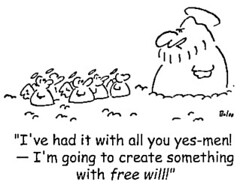
Does Liberty require free will?

Is there "free will" in heaven? What...
Is there "free will" in heaven? What about "free will" in life?
 (Photo credit: Zombie Inc. Wholesale Zombies for Over 25 years)
Ah, the eternal question.  Expressing an opinion affirming existence of free will, as a recent article in the Economist's sister magazine, Intelligent Life does, is to open the floodgates of dogmatism.  That can be fun, and a bit mind-stretching, but often seems to deteriorate into a "conversation" where people are actually talking past one another.  Yet political philosophers--especially libertarians--seem to need some kind of assumption of moral agency for their speculations to have meaning.  How can it make sense to talk about "liberty" if humans have no capacity for independent choice?

Does it even matter?  If to feel that one is free is to be free, isn't that enough?  That leads us down some dark paths.  Brains can be manipulated, and so can perceptions.  As the technologies of social control grow more effective, it's conceivable to live as a community of happy robots, each convinvced it is free, each acting according to plan.

The more we look, the more the philosophy--and the language--get in the way.  For one thing, what is "free will"?  Does it mean an "uncaused cause," or "a nonlocal thought," or is it simply the sense that we feel we weigh and struggle with alternatives before committing to a course of action?  Perhaps the best definition I've seen comes from the comments to the aformentioned article:
A biological or AI system has free will if its future behavior cannot be predicted solely by observing its past behaviour or external communications. A stronger definition would require inability to make such prections regardless of the methods used (eg deep scans of arbitratry complexity of the brain/system). I suspect humans have free will only in the first form of this definition, though for now there probably exists no technology to refute free will of the stronger kind either. (Thomas Anantharaman).
Or how about this one?  Also from the same comments section:
While recognizing the logic of determinism, I choose (?) to invoke "freedom for all practical purposes," meaning behavior that cannot be predicted and anticipated by another agent is effectively free. The brain and its behavior are sufficiently complex that it takes as much or more effort to predict and thereby control it as to "live" it. And that means we are all practically free and that no one has the ability to control others without incurring a high cost. A sufficiently complex machine would become as free as we are, if it took more effort to control it than that effort was worth in economic terms. (Thomas Earle Moore)
The no free-will bus campaign
The no free-will bus campaign (Photo credit: morgantj)
Perhaps the best we can hope for is to be too complex to predict, too complex to plan, too complex for outsiders to control.  If that is happening, and I have the occasional power to self-modify my own habits of action and mind, that's good enough for me.  And it's more than valuable enough to preserve.  While a free will does not require a free society, a free society implies the possibility of free will.

NEURONS V FREE WILL | More Intelligent Life

27 January, 2012

Global Threats

English: An anxious person
Image via Wikipedia
The ink is dry on the contract for the new textbook I'm to co-author.  It's entitled Global Threats (CQ Press, 2013), and I'm a little anxious about it.  Last time I tried to write a textbook it was on Soviet politics--and the Soviet Union collapsed.  Trying to keep up with what was happening, while it happening, was impossible. Even if I could have kept up with everything up to the day I handed in my sections, the book would have been overtaken by events long before it was out the door of the publisher.  Trying to do the impossible produced a lot of unnecessary anxiety then, and thinking about it still triggers a little anxiety today.

The good news is I know better now than to attempt the impossible.  As long as I keep my perfectionist tendencies in line, this new book should not only be possible, but fun.  How often do I get (paid) to speculate on as many possibilities as I can think of for the collapse of nations and civilizations?  The book encourages brainstorming, and that's one of my favorite activities.  It's as if I get to write a bad science fiction novel without the going to the trouble of developing believable characters.

So if I get anxious it's my own fault: I'm the one who can choose to set the bar higher than any real person can achieve, or worry about how my work will be received by others.  Instead, I'll do my best to produce good work and have some fun.

03 January, 2012

One empire down, one to go?


Here's an interesting perspective on where we've been and where we're going, as articulated by Monika Halan:
The fracturing post-World War II equations showed through the plaster in 2011. The 63-year period from 1945 to 2008 will be remembered as the time when two dominant ideas about people and money, and how we choose to organize ourselves around these ideologies, died. One version delinked people from money; the other put money before people. The first collapse was in 1991 when the dominant interpretation of collectivism shattered the Soviet Union into 15 shards. The classless, moneyless, stateless, egalitarian society, which took from each according to his ability and gave to each according to his need, crumbled under the weight of authority and effort that was needed to impose something so state-centric and unnatural in place. Progress does get measured by money, and the severe scarcities and the dysfunctional economies of the Soviet bloc hastened the collapse—the delinking of people and money did not hold true. 
But handing over the keys to the market caused another collapse, and 2008 was when the interpretation of individualism in the form of predatory capitalism began its death dirge when the US’ financial sector demonstrated what unregulated greed can do. This version of capitalism (which was not what Adam Smith envisaged) delinked risk from reward, made a section of labour behave like capital, and made governments subordinate to the transnational corporation. That version of capitalism, emboldened by the breakdown of communism, pushed for and got what were called “free” markets and “less” government. But markets, as was later found out, were not really free—but compromised by the 1% who held the levers of control to move the system. And move it they did, towards appropriating more and more for themselves.
But there's more to it than that: both post-war empires overextended themselves. The Soviets couldn't pull back and manage a real "restructuring" (perestroika) and failed to keep "openness" (glasnost') under sufficient control to keep the empire intact. Today, with greater technologies for information transparency--and heavy-handed attempts to restrict it--the parallels for the US are too close for comfort. Do we really think the TSA is just for the external threat?

And then there's the Chinese. The Chinese government is watching the various "Springs" of recent history and finding it's too vulnerable for comfort. Little noticed in the growth of Chinese military power is the fact that the internal security forces now have a budget that rivals that of the PLA.

Old patterns of social organization and control are breaking down, but there's no consensus on what will replace them. Probably the best we can do is encourage experimentation, and see what works (and for whom) in various circumstances. But that's precisely what those in power are most opposed to trying. This could get interesting.

Liberty, Equality, Fraternity - Home - livemint.com

27 December, 2011

Get your own state!


I love micronations. There's something appealing--and pleasantly eccentric--about sticking a flag on a rock, declaring it to be an independent country, and naming yourself emperor. Who hasn't wanted to do that, at one time or another?  Especially at tax time?  I've always admired Sealand.

And sometimes it seems the only way to avoid a big government is to set yourself in charge of a little one.  Seriously, as states come under increasing pressure--and react to it with increasing centralization and restrictions on individuals--I wonder if this may be the wave of the future.

If not for all of us, at least for those who can afford it.
But for now, see Business InsiderCheck Out 10 Of Europe's Oddest Micronations. Three examples:
Kingdom Of Elleore

Location: Denmark
Founded: 1944
Ruler: King Leo III
Estimated Population: Unknown. But the population grows in the summer time.
Estimated Size: 15,000 square meters.
About: A small island off Denmark's Northern coast, the Kingdom of Elleore was founded and declared independent when a group of school teachers bought it to organize a summer camp in 1944. The micronation has issued numerous stamps and coins and has had six monarchs since its independence. 
BjornSocialist Republic

Location: Sweden
Founded: 2005
Ruler: President Oskar Augustsson
Estimated Population: Usually Zero.
Estimated Size: Six square meters.
About: Located on a stone that "looks like a tractor," this tiny socialist state near the Bos Islands doesn't recognize Swedish laws and has its own hymn. It made the news when Sweden refused to recognize a marriage between two citizens that allegedly took place on the tiny rock. It claims to be the smallest republic in the world. 
Principality of Filettino

Location: ItalyFounded: 2011
Ruler: Luca Sellari
Estimated Population: 550
Estimated Size: 30 square miles
About: Demonstrating its frustration with Italy's economy and austerity measures, this village decided to break away from th Italian government in August this year. The village intended to invite Prince Emmanuel Filiberto from the deposed Italian royal family to be Prince of their principality.
See the others at Business Insider. And don't forget to renew your passport for Sealand!

12 December, 2011

Oil on the flames (cute title, huh?)

Exxon-Mobil is throwing in with the Kurds in the upcoming battle over Iraq.  The battle takes off again.
Whatever the prospects of finding oil in the north of Iraq, observers are surprised that Exxon is prepared to hang its future in Iraq on the outcome of the power struggle between Iraqi Kurdistan and the central government. Control of the right to explore for oil and exploit it is crucial to the authorities on both sides since they have virtually no other source of revenue. 
The Kurds have won a degree of autonomy close to independence since the fall of Saddam, and the ability to sign oil contracts without reference to Baghdad will be another step towards practical independence and the break-up of Iraq. A parallel would be if the Scottish government were to sign exploration contracts in the North Sea without consulting London. 
What makes the Exxon-KRG deal particularly inflammatory, says Mr Shahristani, is that three of the six blocs where Exxon is planning to drill are understood to be "across the blue line – that is outside the border of the KRG". This means they are in the large areas in northern Iraq disputed between Arabs and Kurds since 2003, but where the Kurds have military control. 
The government must now decide if it will make good on its threats and replace Exxon at a mammoth oil field called West Qurna 1 at the other end of the country, north of Basra. Iraqi oil officials hint that Royal Dutch Shell might replace the American company. 
Both sides have much at stake. The Iraqi government is totally reliant on its oil revenues to pay its soldiers, police force and civilian officials. It needs vast sums to rebuild the country after 30 years of war, civil war and sanctions. In 2009, it began to expand its oil industry by signing contracts with firms such as BP, Royal Dutch Shell and Exxon to boost production in under-exploited and poorly maintained fields. 
These companies thereby gained access to some of the largest fields in the world, each with reserves of more than five billion barrels. Vast sums are being invested, mostly around Basra in the south of Iraq. Oil output, now at 2.9 million barrels a day, is due to rise to a production capacity of 12 million b/d by 2017, potentially putting Iraq on a par with Saudi Arabia as an oil exporter.


Since the Kurds have had a bad deal for generations, my sympathies are with the Kurds.  But even if they succeed to get the state they want, the transition is going to be hard.

Exxon's deal with the Kurds inflames Baghdad

29 November, 2011

Boldly going where we've never been before

From the Institute for the Future, a visualization of trends and where they may be leading us


A look at 'the future of science: 2021, from CNN.com

Would anyone care to speculate on what some of these imply for politics and economics?  It sometimes seems like most political discussion is analogous to medieval debates over angels, pins, and biblical interpretation.  I suppose it seems important in its own context, but the world is passing it by.

04 August, 2011

Ideas have consequences

Especially economic ideas. For example, what we assume about discounting the future--whatever we assume--likely leads to error. It does, however, clothe our assumptions in the image of "science."

Mark Buchanan - Bloomberg:
Pretend, for example, that we want to see if it is worth creating a costly marine sanctuary that could take many years to establish and even longer to effectively protect a population of endangered salmon or cod. The costs of the sanctuary come mainly in the first years -- the expense of setting it up and policing it, as well as perhaps millions of dollars a year in lost fishing revenue. The most important benefits, on the other hand, may come in the distant future. Even if the fish population might increase 100-fold, creating a sustainable fishing industry 500 years from now that is far more valuable than today’s, economists would discount the advantages coming in those distant years almost to nothing.
*************

[But]...Geanakoplos and Farmer find that the correct formulas for discounting over long periods don’t follow the textbook exponential form. The math is tricky (I’ve put some discussion of the technical stuff on my blog. But the consequences are not. Using a standard model from finance for interest rate movements (with an average rate of 4 percent), the authors show that, for the first 100 years or so, their correct form of discounting gives results that are similar to those that come from traditional calculations. But at 500 years the standard exponential discounts the future not just a little too strongly, but a million times too strongly. And it gets worse after that.
Going back to the example of the marine sanctuary, and using the Geanakoplos-Farmer formula, you find that the present value of benefits 500 years from now gets multiplied millions of times compared with the standard analysis. A thriving marine ecosystem in the future, linked with a much larger fishing industry, might well be worth investing in today.
In effect, today’s standard economic methods make the distant future count for almost nothing. And those who always thought this seemed hopelessly naïve turn out to be right.

We really need new ways to think about economics.   Several people are trying to create them, but these people not only have serious methodological problems to overcome--there are entrenched interests  that profit from keeping our indicators and analysis techniques as they are.

15 July, 2011

The failure of the establishment

Walter Russell Mead does it again (from his blog on The American Interest):

I don’t want to make this a habit, and I suspect he doesn’t either, but Paul Krugman and I are once again in (very) partial agreement. We both think the American elite has intellectually and morally lost its way, and we agree that the problems our country faces today have more to do with elite breakdown than popular stupidity.
***
That is not what the elite thinks, by and large. To listen to many bien pensant American intellectuals and above-the-salt journalists, America faces a shocking problem today: the cluelessness, greed, arrogance and bigotry of the American public. American elites are genuinely and sincerely convinced that the American masses don’t understand the world, don’t realize that American exceptionalism is a mental disease, want infinite government benefits while paying zero tax, and cling to their Bibles and their guns despite all the peer reviewed social science literature that demonstrates the danger and the worthlessness of both.
***
[In reality] The American people are less prejudiced, more globally aware and more willing to meet other cultures and societies halfway than ever before. Minorities today are better protected in law and more fairly treated by the public than ever in our history. No previous generation has been as determined to give women a fair chance in life, or to attack the foul legacy of racism. The American people have never been as religiously tolerant as they are today, as concerned about the environment, or more willing to make sacrifices around the world to promote the peace and well being of humanity as a whole.

By contrast, we have never had an Establishment that was so ill-equipped to lead. It is the Establishment, not the people, that is falling down on the job.
Here in the early years of the twenty-first century, the American elite is a walking disaster and is in every way less capable than its predecessors. It is less in touch with American history and culture, less personally honest, less productive, less forward looking, less effective at and less committed to child rearing, less freedom loving, less sacrificially patriotic and less entrepreneurial than predecessor generations. Its sense of entitlement and snobbery is greater than at any time since the American Revolution; its addiction to privilege is greater than during the Gilded Age and its ability to raise its young to be productive and courageous leaders of society has largely collapsed.

It's worth a full read.

I really hope this works

From The Guardian

Iceland is crowdsourcing its new constitution.


In creating the new document, the council has been posting draft clauses on its website every week since the project launched in April. The public can comment underneath or join a discussion on the council's Facebook page.
The council also has a Twitter account, a YouTube page where interviews with its members are regularly posted, and a Flickr account containing pictures of the 25 members at work, all intended to maximise interaction with citizens.
Meetings of the council are open to the public and streamed live on to the website and Facebook page. The latter has more than 1,300 likes in a country of 320,000 people.
The crowdsourcing follows a national forum last year where 950 randomly selected people spent a day discussing the constitution. If the committee has its way the draft bill, due to be ready at the end of July, will be put to a referendum without any changes imposed by parliament – so it will genuinely be a document by the people, for the people.
Comment: Randomly-selected councils. Meetings open to the public. All the usual social media sites. This could prove to be very interesting.

11 December, 2010

Black swans

One of the problems with scenario planning is that it requires plausible scenarios, but that reality is [sic] behaves in ways that are implausible.

--Garry Petersen

He connects his point to the problem of "realistic" fiction in an increasingly unreal world, here

29 August, 2010

The next power in manned space flight: Denmark?


Or is it better thought of as an open-source space program?
A team of Danish volunteers has built a rocket capable of carrying a human into space, and will be launching it in a week's time. The project, which has been funded entirely by donations and sponsorship, is led by Kristian von Bengtson and Peter Madsen.

The rocket is named HEAT1X-TYCHO BRAHE, and its first test flight will carry a crash test dummy, rather than a human, so that the safety aspects of the design can be analysed. It'll launch from a floating platform that the team has also built, which will be towed into the middle of the Baltic sea by a submarine called Nautilus that the pair built as their last project.

The creators are members of the SomethingAwful web community, and have been posting pictures and answering questions there. In response to one question asking what the chances of the person inside dying are, they replied: "Unlike Columbia we're not moving at orbital speeds so 'dying a gruesome death burning up on re-entry' with our kit has a very low outcome probability."

Despite that, the rocket will still break the sound barrier, and subject the pilot (who is forced to stand inside the capsule) to considerable g-forces. As a result, the astronaut will only be able to move his arms, which will be able to operate a camera, the manual override functionality, the exit hatch, an additional oxygen mask and a vomit bag.

When the rocket hits the team's original target suborbital altitude of 150,000m (500,000 feet) and begins to descend again, parachutes will slow it and the team will track it with a GPS link and a "fast boat". The team said: "We should be able to receive a descent plot which can be used in projecting a splashdown ellipse pretty accurately, if we factor in wind speeds and so on."

The first test launch will be taking place on 31 August, 2010, and will set off from Denmark the previous day, as it takes about 36 hours of sailing to reach the site. The team's website is down at the time of writing, presumably due to the attention the launch is generating, but can be found at copenhagensuborbitals.com.

If successful, Denmark will be the fourth country to put one of its citizens into space, following the USA, Soviet Union and China, and the first in the world to do it without government funding.
Open source.  It's not like Denmark, the state, has much to do with it.  But that's even more amazing.

P.S.  I'd hate to be a standing passenger pulling 5g.


27 June, 2009

Conservativism I could live with

Jonathan Rauch , in a review of a book by Allitt that's going on my wish list, examines the rise and decline of the conservative movement into today's "zombie party." And what's that?

We know what happens when movements or parties continue to stagger forward after running out of ideas: They become zombies. Zombie parties are a recurrent feature of electoral democracies. Unable to articulate any coherent or workable governing philosophy, they mindlessly jab at cultural hot buttons, mechanically repeat hardwired tropes ("cut taxes, cut taxes, cut taxes"), nurse tribal resentments, ostracize independent thinkers. Above all, they feel positively proud of their doggedness. You can’t talk them out of it. Think of the Republicans in the FDR years, the Democrats in the Reagan years, the British Labour Party in the Thatcher period, and the British Conservative Party in the Blair period. Think of Japan’s Liberal Democratic Party for most of the past half-century, or France’s Socialists today. To get a new brain, zombie parties usually need to spend years out of power or wait until a new generation rises to leadership.

The current Republican Party--and, I dare say, the Libertarians (the Party, not philosophy)--could get a shamble-on part in the next George Romero movie.

"The refusal of so many of my fellow conservatives in the United States to adapt their thinking to facts and realities does not demonstrate their adherence to principle," David Frum recently wrote in Canada’s National Post. "It demonstrates a frivolous indifference to the responsibilities of political leadership." But Frum will tell you that his admonitions fall on deaf ears. "These days," he writes, "the question I hear most from political comrades is: ‘What the hell happened to you?’ " There are smart, modern people in the Republican Party and the conservative movement. But the movement is in no mood to listen to them.

History looks a little different from this perspective. For example, the Civil War is " 'a conflict between two types of conservatism.' Southern conservatives fought to conserve the South’s distinctive society, its time-honored traditions; northern ones, to conserve an indivisible, democratic nation-state." In our era "conservatives," in all their variety, were only able to keep it together as long as they did because of the fear of communism and the papering over of real ideological rifts.

The paper's gotten too thin. Tax cuts aren't always the solution. The growth of government probably can't be reversed, because for the most part people want a big government--so long as it is doing the right things.

Some conservatives do have ideas: Bruce Bartlett champions the idea of a Value-Added Tax (VAT) because, as well as raising funds, it can get government out of the micromanagement-by-taxation system (with all its inequities, inefficiencies, lobbyists, and corruption). Charles Murray builds on Milton's Friedman's call for a negative income tax, suggesting that all federal government transfer programs be cashed out and replaced by direct checks for $10,000 to every non-incarcerated American over the age of 21. Call it socialism, as I'm sure some conservatives will. Call it a Guaranteed Annual Income. Call it a Social Dividend (as Robert Heinlein alluded to in several of his novels). Labels don't matter. Getting a foundation of support to everyone, as a benefit of citizenship, equally, gets government out of the business of managing lives and playing political games with people's survival. Would it be perfect? Hell, no. This is politics. But it's certainly worth a look. And maybe, when the Republicans (or the Libertarians) have been wandering in the desert long enough, they'll find the courage to consider it.

Conservatism: Attack of the Zombie Party